

Personalized Cardiovascular Treatment through CFD
flowCare uses patient-specific computational fluid dynamics (CFD) to help clinicians plan treatment before they treat. Our current focus is cerebral aneurysms: weakened, bulging areas of brain arteries that can rupture and cause life-threatening bleeding. Starting from 3D models of each patient's cerebral arteries, we simulate blood flow before and after surgical clipping and endovascular coil embolization, and compare how each option changes velocity, pressure, secondary flow, and wall shear stress in and around the aneurysm, including the transitional and turbulent flow common at the middle cerebral artery bifurcation.
Because image-based CFD is computationally expensive, we also explore how deep learning can make these simulations fast enough for clinical use. With human factors collaborators, we are mapping the steps of endovascular coiling to design a mixed reality and AI system for training clinicians in the procedure.

Develop personalized treatments for cardiovascular diseases based on patient-specific numerical models

Principal Investigator
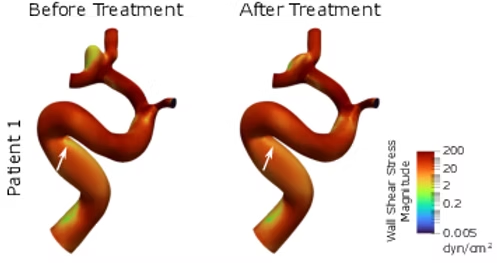
Wall shear stress in a patient's middle cerebral artery before and after aneurysm clipping (Davidson et al., 2024).
We design intelligent medical decision-making solutions to improve health equity.
111 Research Dr., Rm. C346, Bethlehem, PA 18015
+1 (610) 758-4096
taebilab@gmail.com
© TaebiLab. All Rights Reserved.
Adapted from a design by HTML Codex