Dr. David Casagrande
teaching


STEPS Building, Room 436
Lehigh University
1 West Packer Ave.
Bethlehem, PA 18015
Tel: (610) 758-2672

These are courses I teach at Lehigh University. Feel free to contact me about any of these classes.
 |
|---|
Intro to Environmental Studies (EVST 1)
The study of environmental issues from the perspectives of the social sciences and humanities. This course includes a brief overview of environmental history, ethics, politics and economics. The primary goals are to learn critical thinking and some basic social science methods from sociology, psychology and anthropology. We use these to critique environmental policy. Issues we discuss include energy & climate change, endangered species & biodiversity, water & air pollution, water scarcity, sustainability & resiliency, agriculture, and environmental justice.
Lehigh Launch Ecuador
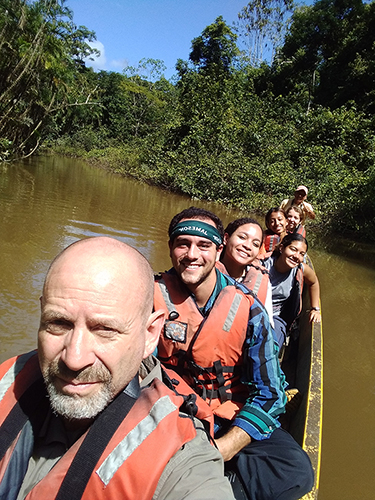
Lehigh Launch Ecuador was a full semester program in which newly-admitted students spent their first (Fall) semester in Ecuador. The program was launched in Fall 2022 and repeated in Fall 2023. It focused on environmental sustainability to take advantage of the rich biological and cultural diversity of Ecuador. Students were required to take a biology course focused on the major ecosystems of Ecuador, a course on indigenous cultures of Latin America and an integrative first-year seminar. They were also placed into a Spanish course based on their level of proficiency. Professor Casagrande was the Faulty Director and taught two of the courses. Students and faculty spent ten weeks in Quito, three weeks in the Galápagos, and five days deep in the Amazon Rainforest. While in Quito, students resided with Ecuadorian host families. The program was academically rigorous and emotionally challenging. Students integrated what they were learning in all four courses with their lived experience to develop personal meaning and research questions. The integrative seminar included self-management skills, like stress management and emotional intelligence, and included instruction in mindfulness meditation.
Urban Permaculture (EVST 127)
In this course, students work in Lehigh's Southside Permaculture Park to combine social, political, economic, engineering, and ecological modes of thinking in the design, construction, and evaluation of a permaculture food garden that serves as a living laboratory and interactive classroom to teach about sustainable urban living.
Socio-cultural Foundations of Environmental Policy (EVST 304/404)
This course is based on the premise that social and ecological sustainability require new policy approaches. Drawing on social, organizational, and behavioral theory, students will learn techniques for analyzing and critiquing existing environmental policies and designing more effective policies. Case studies highlight how cultural values, social norms, public opinion and politics shape policies and their outcomes. We examine the entire policy process from how environmental problems are defined, to how organizations implement policies and how policies are evaluated.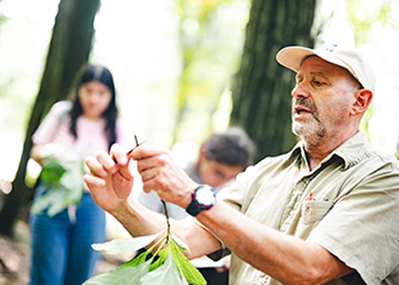
Ethnobotany: People and Plants (ANTH 353, EVST 353)
This course explores the meanings and uses given to plants by diverse cultures in their unique ecological settings. Ethnobotany combines botany and cultural anthropology to study how people classify, use, and manage plants for medicine, food, and ritual. This course introduces the history, methods, theory, and practical applications of ethnobotany, including plant conservation, sustainable development, and cultural survival. Special emphasis will be placed on learning to do ethnobotany through collecting plants for herbarium specimens and student research projects.
Indigenous Cultures of Latin America (ANTH 184, LALS 184)
In this course we examine the Latin American experience by looking at social change from the perspective of indigenous peoples. The main goals are: 1) to develop an appreciation for the diversity of cultures found in Latin America; 2) to develop anthropological concepts like cultural ecology, ethnicity, acculturation, religious syncretism, and resistance; and 3) apply these concepts and critical thinking to social problems. Issues will include cultural survival, human rights, and environmental/cultural sustainability of indigenous peoples of Latin America. The course is divided into five sections. The first part provides an historical perspective. This is followed by four case studies chosen to represent resistance and change from a variety of cultural and theoretical perspectives. Cultures may include the Tzeltal Maya and Nahuatl of Mexico, Kayapo of the Brazilian rainforest, and the Aymara of the Bolivian highlands. How are each of these groups similar and yet different? How have European and indigenous cultures blended to create the cultural diversity we see today? Will these cultures survive or become extinct in this era of high migration and rapid globalization? We will examine these and other questions in detail through extensive reading, writing, and discussion, supplemented with lectures by the instructor.
Download full CV
"An open mind requires an open heart."