Introduction
Thank you for your interest in our program
here at Lehigh University. The
Department
of Earth and Environmental Sciences (EES) has 15 full-time faculty
that cover a broad range of disciplines in Geology, Ecology, and
Environmental Science. I am a geologist and geomorphologist specifically
interested in the long-term evolution of landscapes, the fluvial
response to active tectonics, and how tectonic, climatic, and autogenic
processes conspire to build stratigraphy. In these respects, I am
very interested in re-learning how to read the stratigraphic, and soil
stratigraphic record in terms of the processes that created it.
EES has active research programs in all of these areas and we are
aggressively recruiting outstanding graduate students to build the
graduate program in these and related disciplines. The faculty I
collaborate and interact with most closely here are Ken Kodama
(paleomagnetism, rock magnetics, and cyclostratigraphy), David Anastasio
(structural geology), Peter Zeitler (geochronology), and Steve Peters
(aqueous geochemistry). We have some great expertise in
environmental change in our Department and I maintain close research
ties to many other researchers around the world. Visit my research page
to learn more about active and on-going research collaborations and
projects. Research in
surficial processes is broadly represented in EES.
Solid Earth
Research Group Environmental
Change Research Group
Geomorph
Facilities
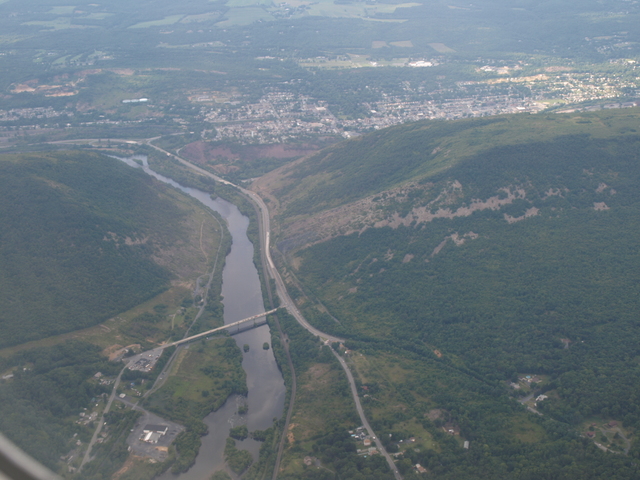
OK, OK!!! This is not the view from the University (wish it was). But this place is real close by! It is the view looking northeast at the Lehigh water Gap near Palmerton, PA. This, and the nearby Wind Gap are places where W. M. Davis and company struggled to understand the origin of transverse drainages. Lehigh University is actually located on the northern flank of Pennsylvania’s Blue Ridge (South Mountain) and has a commanding view of the Lehigh Valley (Great Valley) and Ridge and Valley of the Appalachians to the northwest. This is the landscape of Davis and Hack. It is where the great geomorphic discourses on long-term landscape evolution were born and continue to be lively debated. Far from a "dead" orogen, the Appalachians have a complicated post orogenic exhumational history and stand as one of the best studied orogens in the decay stage of its evolution. These studies, some of which are now ongoing funded research projects in the EES Department, are investigating the causes of late stage rock-uplift and exhumation through the relatively new technique of He/U-Th thermochronology. Over a distance of only 250 km, one can travel from the subsided Tr-J rift-flank uplift buried under a wedge of Coastal Plain sediments, across the Fall Zone, a flexurally-maintained hinge of the isostatically-rising continent and subsiding Coastal Plain, through the high grade metamorphic heart of the formerly Andean-scale late Paleozoic Appalachians on the Piedmont, to a continental rift basin formed during a time when the area around Lehigh looked like the Basin and Range, into the Ridge and Valley, the fold and trust belt of the late Paleozoic Appalachians, and finally, the Allegheny Plateau, the seaward facing escarpment marking the present-day location of the drainage divide in its slow, but methodical westward march.
In addition to the exciting orogen-scale
tectonic geomorphology research in the Appalachians, the setting is well
suited to studying climatic, ground water, and coastal processes. A wide
range of glacial and periglacial deposits in central and eastern
Pennsylvania preserve a rich record of the effects of past climate
changes on landscapes. Ground water geomorphology is well-expressed in
the numerous karst systems underlying Pennsylvania’s carbonate valleys.
And easy access to beaches on the Atlantic coast provide a hands-on
experiences of coastal processes and change.
The research and graduate program for geomorphology students is decidedly field-intensive and designed to afford opportunities to learn about the geomorphology in Lehigh’s own backyard, as well as the individual's location of study. Current research is motivated by three primary interests:
 Recent and current
geomorphologic and related research projects include the studies of
these students:
Recent and current
geomorphologic and related research projects include the studies of
these students:
Josh Gonzales completed his M.S. work in the spring of 2019. Josh has developed a model of the response times for streams in the Piedmont of southeastern PA, and is applying that to test hypotheses of crustal deformation driven by the Reading-Lancaster seismic zone. Josh has recently competed an appointment with the National Park Service in Arizona, and is now pursuing a graduate degree in Civil Engineering at UNLV.
Ethan Kurak completed his MS in the spring,
2021. Ethan was funded by the PA Geological Survey and
EDMAP. He worked along the Youghiogheny RIver in SW PA, mapping
and dating terraces. See his results in the research
pages. Ethan is now pursuing employment in his home state of
Minnesota.
Ben Bliss completed his MS in the spring, 2021. He worked on cyclostratigraphic models of deltas at small, medium, and large scales. Ben was funded as part of the NSF-TESPRESSO project. See some of his results on the research pages. Ben is now employed in the geotechnical field in Vermont.
James Fisher completed his MS in the spring,
2021. He was co-advised by Dave Anastasio. James pursued
numerical modeling of fluvial topography in the northern
Apennines. He developed a number of Matlab codes that are now
served out from GitHub. James is pursuing employment or a Ph.D.
I
encourage you to contact these folks for a candid assessment of EES
and working with me as an advisor. Please also visit the research pages to learn more about
research project opportunities.
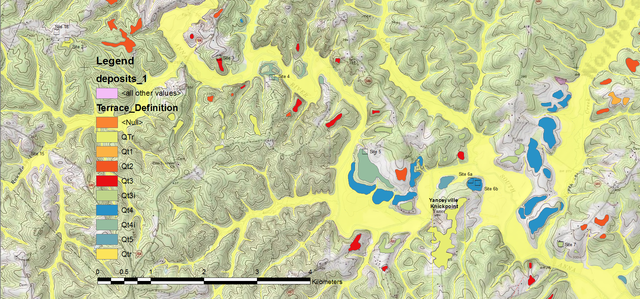
Part
of the river terrace map of the South Anna River, completed by Helen
Malenda.
A reasonable measure of what prospective students might expect out of a graduate degree from Pazzaglia's program at Lehigh is to know what former students are now doing. Keeping in mind that these folks have driven their own success, here's a list of the current activities of former students where I was the major advisor (more or less in the order of their graduation):
The graduate student in geomorphology can expected to take a wide range of course offerings in EES as well as supporting related sciences from other Departments, particularly Civil Engineering. Specific course offerings (400-level are graduate courses) in any two year teaching cycle may include (* = core course):
For more information, please feel free to
contact the Department of Earth
and Environmental Sciences. You can fill out and submit an
application via the web by following this link.
Also, please feel free to email or call Frank
Pazzaglia at (610) 758-3667.