Abstract
Status before restructuring
Reason for reorganizing
Creating the new organization
Major Issues
Functional-based
versus cross-functional teams
Who Leads the
Charge
Avoiding
"downsizing" fears
Titles
(or what's in a name)
Job levels
and broad banding
Relocating
Staff and Operations
Getting buy-in
Achieving Organizational
Metamorphosis
Successes and failures
Final words of wisdom
Metamorphosis is defined as the change of physical form, structure, or substance especially by supernatural means. Lehigh University’s merging of computing, telecommunications, and libraries into a cohesive whole has at times seemed to require the use of magic or witchcraft to succeed. Lehigh has approached this merger from the perspective of re-engineering our organizational processes to better serve our clients.
This paper describes the steps taken at Lehigh to achieve a cohesive integrated organization. The use of client and staff input to drive the restructuring process has been a critical component of the process. This paper also outlines the resultant organizational structure along with staff and clients' perceptions of the new organization.
The Metamorphosis of Libraries, Computing, and Telecommunications into a Cohesive Whole
Prior to July 1996, Lehigh's information and technology services were organized into two major areas reporting to the Provost. The library staff, which had been reorganized in July 1995, reported to the Director of Libraries and had seven associate directors. To many people on campus, that reorganization appeared basically as a change in the titles of existing library managers without any real planning regarding the needs of the institution. Computing and telecommunications — consisting of academic computing, administrative computing, network support, a computer store, and telecommunications — reported to the Associate Vice President of Computing and Telecommunications. Some of those groups had sprung up in ad hoc fashion in response to various initiatives at Lehigh. For example, the formation of Lehigh’s Computer Store in 1986 was the result of having to put in place a mechanism for selling six thousand computers over a five year period to finance the distribution of six hundred computers to all faculty and public sites. The network support group was created in the early 90's to respond to the tremendous expansion of local area networking into academic and administrative departments.
Over the years a strong working relationship developed among all of the above groups, and there were sincere efforts not to duplicate services. However, in many instances overlap was impossible to avoid. Some examples of the overlap included: web training and support, which was at times provided by administrative computing, academic computing, and library staff; and, software licensing, which was done by academic computing, network support, administrative computing, and library systems staff.
The computing, libraries, and telecommunications environments were structured in fairly typical ways, with each being a separate unit. Distinct structures had evolved within each unit. Organizationally, there were directors, managers, and assistant managers — with varying degrees of responsibility within and across the three units.
In general, computing/telecommunication services and the university libraries had excellent reputations on campus.
Given the fine reputation of Lehigh’s information service organizations, the restructuring was not perceived as being started to fix broken organizations but rather to make a stronger organization using the strengths of all parties. The major impetus for restructuring was that the Library Director and the Associate Vice President for Computing and Telecommunications were both resigning from their posts. The Library Director was taking advantage of an early retirement offer, and the Associate Vice President for Computing and Telecommunications had decided to return to full-time teaching. The two approached the President with the suggestion that this might be an opportune time to merge the two organizations. The President incorporated this suggestion into the university strategic planning process and a new position — Vice Provost for Information Resources — was created. Lehigh had previously tried to combine the reporting structure of libraries and computing under one person in the late 80's but had reverted to a separate reporting structure in about six months. Major reasons for the failure the first time were the vested interests of the parties involved and no clear understanding of what benefits the combining of these organizations would bring.
Why the time was right to create Information Resources in the mid-nineties had to do with a number of variables. The case statement for the Information Resources planning and restructuring process (Hirshon, 1996) states:
Lehigh has the opportunity to increase significantly the value received from its investments in its information systems through more coordinated approaches to computing and information resources. The time is right to restructure because a number of other legacy (dying) systems in computing and the libraries need replacement. For example, the recently announced SAFAHRIS 2000 project for replacing our enterprise-wide information systems concurrently with the Information Resources restructuring should bring a synergy to the entire process.
We must develop a long range strategic information resources plan that comprehensively encompasses our client information technology needs and explores how to meet those needs with traditional and emerging technologies. We must alter our current strategy of purchasing equipment as a capital expense rather than as an operating expense or strategic resource. An information technology infrastructure plan is essential to help the University understand the full costs and potential benefits of funding manageable annual upgrades or replacement of systems rather than waiting until the pressure mounts to perform wholesale changes.
It was also thought that an integrated approach to providing services needed to be examined. The crisis in technology support was becoming apparent on-campus as more and more customers were using information technologies to perform the functions of their job. As McClure et al. (1997) state:
A decade ago, fewer than 20 percent of our faculty, staff, and students were active consumers of technology services and support. Today almost all of them are to some degree.
It was also apparent that there was a trend to consolidate libraries, computing, and telecommunications. It was thought that merging these groups would create synergies and new working relations that would outweigh the initial cultural differences. A major redefinition of responsibilities for staff and clients would be needed to properly accomplish the merger. Everyone involved in the restructuring process understood that this was not going to be a reshuffling of boxes on an organization chart but rather a true merging of the functions of all three organizations.
Client needs were used as the major driving force when designing and implementing the new organization. The following values were drafted as an initial starting point in dealing with clients:
VALUES REGARDING OUR CLIENTS (Hirshon, 1996)
Mission-Oriented. All processes and activities will add value to achieve the University's mission in teaching, research and service. We will foster a single mission for all areas of our operation. The primary organizational drivers of LUIR (Lehigh University Information Resources) are the service and information needs of our clients.
Responsive to Clients. All LUIR units will deliver relevant, timely, and cost effective services and systems that meet or exceed the needs of the University's internal and external constituencies. Customized services should conform to general standards, fit within overall priorities, and be adaptable. Our staff, services and systems will be responsive and reliable.
Encourage Innovation and Service. LUIR will explore and implement innovative new services while maintaining high quality core operations. LUIR will provide consultation services that are active (such as outreach to key constituencies) and responsive (such as assistance desks and response teams). Internally, LUIR will encourage creativity, resourcefulness and constructive entrepreneurship to enable us to create and take advantage of opportunities.
Logical and Intuitive Organization and Processes. Our structure will be rational and intuitively understandable so clients can readily identify appropriate points of contact without encountering bureaucratic impediments. LUIR should maintain a sense of organizational identity for the library and computing functions, but seek a high level of integration and collaboration. Administrative policies, procedures, and systems will be based upon an objective analysis of best practices and functional needs.
Cost-effective and Accountable. LUIR staff must be prudent stewards of the significant resources entrusted to our care by the University. The organization will focus on core operations, and will modify or eliminate activities that fall outside our mission. Process re-engineering is essential to improve service and reduce costs as a first step to continuous process improvement. We will provide information resources and services at a cost equal to or better than we could obtain from qualified external providers. LUIR will establish and communicate clear benchmarks, and constantly measure organizational and individual performance.
The following service recommendations were made as a result of a series of focus groups and meetings with our clients:
The Client Services restructuring team developed a preliminary client services plan outlining the services to be provided and the level of service to be obtained. This service plan was recently revised to reflect the new organizational structure. This team also examined the areas of overlap within the existing organizations, and the lead restructuring team outlined strategies to eliminate those overlap areas (Foley, 1996).
After completing the draft strategic plan, the lead restructuring team examined a variety of new organizational models and decided that the main focus of the new organization would be Client Services cross-functional teams assigned to colleges and departments. The final organizational model chosen had the following three major groups:
Information Management Services consists of the following two functional teams: Information Organization Services (which is responsible for acquisitions and serials control, cataloguing, web interface design and on-line catalogue support), and Information Delivery Services (which is responsible for circulation, stack management, preservation, and fee-based services).
Technology Management Services consists of the following five functional teams: Communications and Computer Operations, Technology Installation and Maintenance Services, Instructional Technology Support Services, Systems and Network Administration, and System and Network Design.
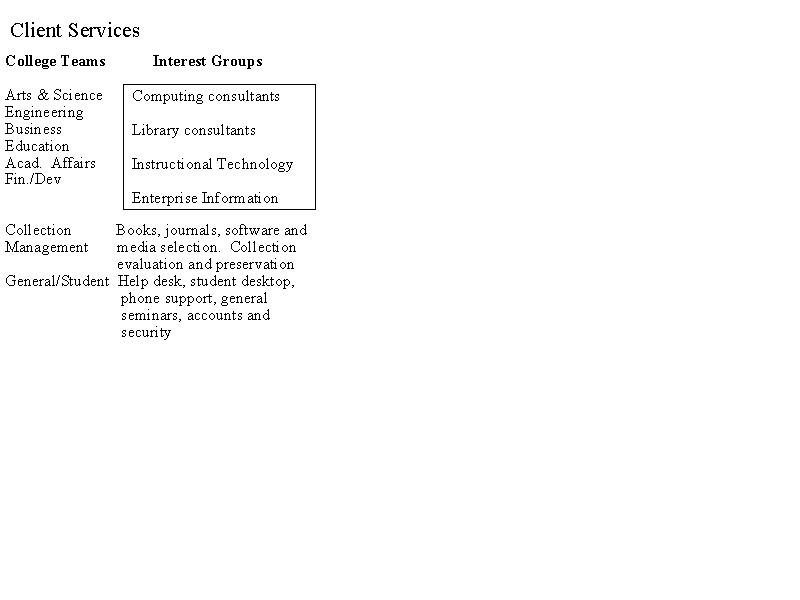
Client Services consists of: six cross-functional teams to serve Lehigh’s colleges and administrative departments; a Collection Management team; and, a General/Student Services team. The college/departmental teams are each comprised of computing consultants, library consultants, instructional technology consultants, and enterprise consultants. These teams are responsible for providing outreach support services for their associated clients. The Collection Management team is responsible for book, journal, software and media selection, special collections, and ongoing preservation activities. The General/Student Services team is responsible for running a help line and two help desks, all of which provide services for library, computing, and telecommunications problems. This team also has responsibility for residential computing, computer authorizations, security and data integrity. Another important aspect of the Client Services teams are the four functional interest groups — for computing, library, instructional technology, and enterprise information (see Figure 1).
Two additional groups that resulted from the restructuring are: the Administrative Services and Planning group, which has primary budgetary and developmental responsibilities; and, the Advanced Technology group, which consists of one person whose responsibility is to draw from other parts of the organization to lead projects associated with advanced technology.
Functional-based versus cross-functional teams
A major area of contention within the new organization has been the emphasis on the Client Services cross-functional teams. Many staff thought, and still feel strongly, that clients would be better served if Client Services was organized according to traditional functions rather than by college and department cross-functional support teams. Further, along with the cross-functional college-based teams, the organizational model initially had virtual functional teams in each of the four areas (computing, libraries, instructional technology, and enterprise information). The virtual functional teams were later reconstituted as "interest groups", with the expectation that more cross-functional activities would occur if the major emphasis was placed directly at the college/department level.
The functional team that has had the hardest time adjusting to the cross-functional approach has been the computing consultant one because of increased client demands as desktop computers proliferate on campus.
The organizational model assigns consultants to specific colleges and departments, which in the ideal world of adequate staffing is exactly what our clients want. However, we do not currently have adequate staffing and are trying to devise mechanisms to relieve the load that has been placed on the computing consultants. For example, we have started an informal liaison program with a number of departments and hope to expand this program during this academic year.
There is also still a lot of concern that the cross-functional teams are not adequately sharing experiences and learning from each other as was hoped when we formed the new organization. Further, our cross-functional team approach in Client Services has caused a number of management problems, with staff at times reporting to multiple team leaders. There are questions of priorities and which team leader should have the final say in assigning tasks. We have tried to address this issue by focusing on the college/department team leader — working in conjunction with his or her group leader — as the primary manager for the purposes of prioritizing activities. However, as large projects loom (especially in the computing area), this at times seems inadequate to address the needs of our organization.
The first and most obvious part of performing a massive restructuring is to make sure you identify strong, capable, and risk-taking leaders within the new organization. Prior to any assignments, all staff were given the opportunity to express not only whether they wanted to be part of management but also in what part of the organization they wanted to be. About 80% of the staff voluntarily completed forms on which they were to indicate their preferences.
The highest layer of staffing selected was that of the "group leaders" (formerly thought of as directors). The group leaders where chosen directly by the Vice Provost. His selection criteria included "out-of-the-box" thinking, a sense of humor, and the willingness to make the new organization succeed. After the group leaders were selected, "team leaders" (formerly thought of as managers) were chosen by the respective group leaders in conjunction with the Vice Provost. This group of leaders was then given the task of working within our current staffing parameters to create the new organization.
As any restructuring begins, the first thought in most people’s minds is the possibility of "downsizing" the organization. All planning documents articulated that the restructuring effort was not an attempt to downsize the organization, but they also stated that position re-allocations or reassignments were possible. However, the total number of positions in Information Resources was reduced during the process. The most notable casualty of the restructuring was the Computer Store. The Store, which was expected to run on a cost-recovery basis, was no longer able to generate sufficient income to do so. The Store employed seven staff members, all of whom were placed within the current Information Resources organization. We were able to do this primarily because of the vacancies created by the staff turnover caused by the restructuring.
Staff turnover was most pronounced in the Client Services area, where approximately seven staff members in the computing area found new positions outside of the university. The causes of the turnover were many. A number of people found their new role within Information Resources counter to what they felt they wanted to do with their careers. For these people, obtaining positions in an appropriate computer area was not a problem. It did, however, place a lot of stress on the new organization to have to cope with the loss of the highly skilled people and find new people to replace them. The replacements have worked out excellently, which confirms Stein’s (1995) notion that "People grow, develop, get married and have children, and take new jobs — generally enthusiastically. What people do resist is change you want them to make."
Job titles play two important roles. One role is to clearly describe to your clients what you do and the responsibility that you have to make things work. They are also used by staff to clearly articulate to their peers in other institutions their duties and responsibilities. Changes in job titles caused a great deal of controversy within our new organization. Within the old computing and library organizations, two different sets of position titles were used, and we desired to reconcile the two. In addition, our new organization was team-based rather than hierarchical, and we wanted to reinforce this concept through the job titles. The development of new position titles was also seen as an opportunity to give the new organization a fresh start rather than continue the traditional organization of the past. With this in mind, the lead team suggested the titles of "group leader" and "team leader" to represent staff in supervisory roles that would have been analogous to "associate director," "director" or "manager" in our old organizations. (The lead team facetiously also suggested that the Vice Provost should use the title "ring leader" for his position.) A lot of debate within the new leadership group centered around these "new" titles in relation to the more traditional titles held by most people within the university and their counterparts at other institutions. After allowing ample opportunity for all arguments to be heard, and with no consensus likely between those who preferred team-based versus hierarchical titles, the Vice Provost decided to employ the team-based titles. Interestingly, in the nearly two years since we developed our organizational titles, the "team leader" title seems to be becoming more common in the academic computing and library environment.
Initially, new titles were also used for other staff positions, such as "information retrieval consultant" for librarians and "desktop computing consultant" for the computing professionals. However, these two titles have since reverted to the more common titles of "library consultant" and "computing consultant." In retrospect, it would have caused less staff friction, and perhaps less confusion among our clients, if we had originally used more traditional titles which indicated one’s specialty as well as one’s level of management responsibilities.
Creating a new organization from scratch presented the opportunity to rewrite job descriptions — of which there were one hundred and forty — and to have them re-evaluated by Human Resources. We also wanted to collapse the eight professional staff levels to a more manageable number. We worked closely with Human Resources to create wide salary bands that could theoretically provide job growth within the band rather than have staff need to get promotions to new jobs in order to advance. The salary structure was reduced from eight levels to four, with wide salary ranges within each level.
Another concern arising from the re-evaluation of all positions was the possibility of salary reductions based on the evaluations done by Human Resources. However, the overall results were that the majority of the staff remained at the same salary, about one-third of the staff got salary raises, and only a small percentage of staff received less pay (due to a change in level or responsibility).
Still to be done, however, is the determination of a mechanism to allow people to move within each band rather than have to apply for a new job to get an increase in pay.
Relocating Staff and Operations
Another issue that caused concern was the physical relocation of staff offices and service operations throughout the organization. Many people become attached to their office space, and at Lehigh some staff had been in their original location for over twenty years. It was not surprising that some people did not react well to the possibility of having to move to a new location where, in addition, he or she might have staff from different functional areas as office mates.
The decision was also made to physically locate Client Services staff by college/department team rather than by functional area. An attempt was made to group enough of the college/department teams together that functional sharing of knowledge could still occur. The fact that there were three separate buildings to house staff led to some difficulties with this approach. The Linderman Library, which was one location, held our humanities and arts collections; the engineering, science, and social science collections were held in another location, the Fairchild-Martindale Library. The third location, the Computing Center, was adjacent to the Fairchild-Martindale Library. The building in which a Client Services team was located was primarily based upon which college/department the team served. The fact that the Arts and Science team was placed in the humanities/arts library caused the science and social science librarians on the team a great deal of concern. The location of staff in separate buildings still causes isolation from other teams, and regular meetings are needed to keep everyone informed of what is going on within the organization.
In the midst of all of this movement, Information Resources was also preparing for the creation of an Information Commons on the first floor of the Fairchild-Martindale Library; the Commons was to become the central focal point for computing and library help. The former major computing help area was to become secondary to the new Commons, which was a major change for clients.
The most critical element of any restructuring, and especially one of this magnitude, is to obtain buy-in and a sense of ownership of the new organization from staff and clients alike. To obtain buy-in, one must first believe that the staff can genuinely effect the transformation of the organization in a logical way with minimal direction from above. Staff need to be given responsibility to perform tasks, and then given the leeway to design the environment from their perspective with as little direction as possible. The best way to ensure buy-in is to create a feeling of ownership of projects. Staff will feel disenfranchised if decisions that they have made as a group appear to be overturned for no logical reason. Achieving buy-in can be particularly challenging when reorganizing people who come from somewhat different organizational cultures. As Creth (1993) has noted:
On the whole, librarians share similar educational background and a process of acculturation in which they develop a shared philosophy and common values. Computing professionals generally come from a variety of educational backgrounds. Since, there is no common professional and academic preparation, there is no socialization process for a computing professional with entrepreneurial and individual efforts more highly regarded than a focus on the views, standards, or values of a collective group.
So, at the outset, you have two culturally different groups who have traditionally operated in different modes. A compromise must be made on the best methods to effectively get these groups to work together and take ownership of projects. There have been various incidents throughout the restructuring process which have caused staff to lose their sense of ownership of the new organization. As a whole, one needs a set of operating principles that everyone agrees to abide by — from the highest level administrator on down. One of the principles should be the ownership of projects and priorities of the organization along with an understanding of why and how these projects and priorities were selected.
The merging of these organizations requires a major reorientation both culturally and technically. The following cultural stereotypes have been pointed out and heard at times during our restructuring (Hawkins, B. & Battin, P., 1996; Lipow, A. G. & Creth, S. D., 1995):
Librarians are inflexible and resist change
Technologists follow wherever technology leads and thrive on change
Librarians are very services oriented
Technologists have poor service orientation
Librarians partner only when in control
Technologists are blue sky people, not reality/performance-based
Librarians are hell-bent on warehousing everything
Technologists are disinterested in the past
Librarians are passive-aggressive
Technologists are aggressive-abrasive
These stereotypes may seem simplistic in many cases; however, when merging
organizations, it is important to understand the cultural differences
of each to obtain buy-in from the staff as a whole. Another way to get
buy-in is to build on the strength of our differences and use the best
of all the cultures involved to create a new organization having the bests
of all worlds. In the short term, merging these organizations while demands
are increasing has created a general sense of frustration for staff and
clients. The hope is that out of these groups a stronger organization will
emerge.
Achieving Organizational
Metamorphosis
Integrating computing and library organizations is a complex and time-consuming undertaking that is fraught with potential problems along the way. The following key behaviors as outlined by Gillian & Tynan (1997) are important to keep in mind when trying to successfully effect organizational change:
Provide information about the organization to everyone. Keeping all parties informed is one of the hardest parts of any reorganization. To counteract concerns about hidden agendas, provide as much information as possible about budgets and reassignment of responsibilities. At Lehigh, we have made honest attempts to provide an open environment for our staff.
Act as a coach. When creating an entirely new organizational structure, it is important to understand the strengths and weaknesses of your staff, and have enough wisdom and courage to let them come up with solutions to problems on their own. This does not mean relinquishing authority, but working with staff to develop reasonable time frames for projects and ensuring accountability. It is also important to place staff in appropriate positions to best utilize their training and skills, and be willing to change assignments if you feel that mistakes have been made.
Ignore the terrorist. Complaints that are not tied to solutions are easy to make, but are contrary to organizational goals and destructive to any organization. One must encourage staff to start working towards solutions to problems without consistently finding fault or looking backwards to the "good old days". Staff should be aware that complaints that are not tied to solutions are in most instances contrary to organizational goals.
Provide training and development. Training and development need to be stressed throughout any reorganization and must be done in conjunction with regular organizational activities. A number of the training sessions which were held were ineffective due to their disconnection with reality. Staff had wanted to discuss concrete issues relating to the real problems associated with the restructuring. The flexibility to modify training sessions to meet one’s needs, once it becomes apparent that sessions are not working, should be built into any training plan. Development of skills should be seen as an ongoing activity during restructuring, especially when bringing such diverse groups together. Training needs to address the major issues of all three groups, while stressing that priorities for issues should be based on the overall organizational goals of Information Resources and the university.
Let go of structure. In our new organization, there has been a blurring of the lines between groups, and a real need to work together more closely than ever. One needs to instill a sense of ownership throughout the organization. Many staff want to stay within the confines of the organizational chart because they will know whom to blame and will feel safe. A good analogy is the blaming of the goalie in a soccer match when a goal is scored even though the whole team is responsible and anyone on the team could have helped to prevent the goal.
Be willing to live with a high degree of ambiguity and chaos. When one creates a completely new and revised organization, a high level of ambiguity and chaos are likely to occur. These situations will eventually work themselves out as long as people can let go of structures and work on providing solutions. Leadership must be forceful, patient, and cooperative with staff while guiding them in working out the problems that occur.
Don’t wait for consensus. Waiting for complete consensus on any issue can cause paralysis. It is important to know when consensus is useful and when it is not; do not seek consensus unless it is necessary, achievable and you are ready to abide by the results.
Timing is everything. I would also add "timing" to Gillian and Tynan’s (1997) list. Supra & Johnston (1997) point out that "too great a rush to integration likely would cause even greater confusion both for the customers and within the organization, with the latter likely exacerbating the former. Excessive deliberation would stall the process, dissipate momentum, and miss an important opportunity". Lehigh went through its strategic planning and restructuring process in approximately six months; we are currently working on smoothing out some of the confusion that was created by this accelerated time line for change. It is hard to say if a slower time line would have alleviated this situation, but it is important to carefully consider the timing of changes at every step in the process.
The college/department-based model has been well accepted by clients but we have failed in developing enough local support to allow the IR staff to get out of the firefighting stage and work more on managing the environment. The appeal of the distributed support model is hard to argue and has been most successful in our smaller colleges such as the College of Business and Economics and the College of Education. More work remains to be done to develop strong cross-functional teams and to effectively implement the model.
Another problem that we continue to address within our new organization is how to decrease the number of meetings required to keep people adequately informed of what is happening. Having both cross-functional teams and functional interest groups has basically doubled or in some cases tripled the number of meetings that people need to attend to get projects started and keep informed. The increased communications resulting from the meetings, the electronic conferences, and the listserves has at times caused staff to feel as if they were in information overload mode.
The major success of the new organization is that, through all the changes that we have been through, we have managed to integrate two previously separate organizations, increase cooperation, continue to upgrade technology, provide for continuing computing and library training, and develop more cost-effective ways to provide library, computing, and telecommunications services.
Lehigh’s strategic planning and restructuring effort to integrate computing and libraries represented a major undertaking for our staff and clients. The metamorphosis is still taking place and I am sure more magic or supernatural means may need to be deployed to completely work through all of the issues. Staff and leadership of other organizations which are considering such an effort should consider this advice from Lehigh’s Vice Provost for Information Resources to CIOs contemplating merging these organizations (Hirshon, 1997):
Be pragmatic, be daring, but take only realistic risks. Build alliances and partnerships. When things seem to be going smoothly, know that a new problem is around the corner. Show an interest in all operations, particularly those that were not part of your personal background. Be prepared for a long personal learning curve. Recognize that the sphere of concerns and political risks are greater than for a computing or library director alone. If you don't like to juggle with blow torches, look elsewhere for your next career move.
2. Foley, T. (team leader), (1996), "Client Services Plan", unpublished document Appendix (A, B, C), URL: http://www.lehigh.edu/~inluir/irdocs/drftrpt.htm
3. Foley, T., (1997), "Combining Libraries, Computing, and Telecommunications: A Work in Progress", Proceedings of ACM SIGUCCS 1997 User Services Conference XXV, p99.
4. Gillian, M. W. & Tynan, A., (Fall 1997), "Leadership and Transformation in an Environment of Unpredictability", CAUSE/EFFECT Volume 20 Number 3, p52-54.
5. Hawkins, B. & Battin, P., (Spring 1996), "The Changing Role of Information Resources Professional: A Dialogue", CAUSE/EFFECT Volume 20 Number 1, p22-30.
7. Hirshon, A., (1997), "Merging Libraries and Computing: Institutional Decision-Making and Implementation", unpublished summary of CAUSE 97 presentation, URL: http://www.lehigh.edu/~arh5/execsum.htm
8. Lipow, A. G. & Creth, S. D., (1995), Building Partnerships: Computing and Library Professionals, Berkeley: Library Solutions Press, pVII.
9. McClure, P. A., Smith, J. W., Sitko, T. D., (1997), "The crisis in information technology support: Has our current model reached its limit?", CAUSE Professional Paper Series #16, Boulder CO.: CAUSE, p2-7.
11. Supra Jr., J. R. & Johnston, B., (1997), "Toward an Integrated Approach to Information Services Support", Proceedings of ACM SIGUCCS 1997 User Services Conference XXV, p300.