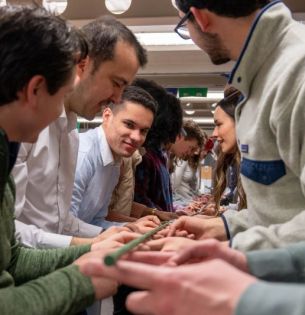


The professional master's degree in technical entrepreneurship is a one-year, full-time, 30-credit mix of design, product development, and entrepreneurship courses. Graduate students in the program come from a variety of undergraduate disciplines, from business and engineering to liberal arts and sciences. They work individually and in teams to develop and commercialize new products while expanding their skills in creativity, prototyping, visualization, process, team and data management, intellectual property creation/management, technology application, and business and economic acumen. Projects evolve from three sources: 1.) In-class creativity and innovation exercises, 2.) Faculty and alumni research, and 3.) Local established and startup companies.
As they develop their ideas, technical entrepreneurship students enjoy access to Lehigh’s extensive laboratory and shop resources, which include 3-D rapid prototyping equipment and a dedicated classroom and Creativity and Innovation Lab. The program features faculty dedicated specifically to technical entrepreneurship courses and curriculum designed exclusively for the program. Each student cohort is encouraged to form teams to develop product ideas and apply for seed funding that is available to support the development of the best product/company ideas.
Teams are mentored by technical entrepreneurship faculty to help them start and grow their companies, employing the resource of more than 50 programs and organizations that are part of Lehigh’s entrepreneurship ecosystem. Students are also connected to a rapidly growing regional community of tech incubation events, resources, and organizations, from tech and startup meetups to venture pitch competitions, hackathons, and economic development resources.
Required courses and descriptions:
SUMMER SESSION 1
TE 301. Creativity and Systematic Innovation Methods (3 Credits)
Creativity methods, anthropological research, painstorming, bisociation, the Kano model, the trimming technique, parameter analysis, decomposition, nonlinear design, DeBono's Six Hats technique, biomimicry, lateral benchmarking, Blue Ocean Strategy, the art of tinkering and other innovation methods. Hands-on labs, individual and team projects.
TE 407. Intellectual Property (IP) Creation and Management (2 Credits)
Intellectual property issues: confidentiality, nondisclosure, agreement not to compete, founders agreements, patents, copyrights, trademarks, trade secrets both domestic and international.
SUMMER SESSION 2
TE 302. Methods in Visual Thinking (2 Credits)
Visualization techniques, visual thinking and envisioning information as taught by Edward Tufte and others, multimedia tools and methods. Appropriate use of technology as applied to new product development, no programming required.
TE 303. Methods in Prototyping, Modeling and Testing (3 Credits)
Generation of mock-ups and looks-like prototypes, electro-mechanical-optical bread-boards design, fabricate, build and test multiple generations of prototypes, computer modeling methods, shop methods, testing, sensors and data collection.
FALL SEMESTER
TE 401. Integrated Product Development (IPD) Process - 1 (3 Credits)
An integrated and interdisciplinary approach to engineering design, concurrent engineering, design for manufacturing, industrial design and the business of new product development. Topics include design methods, philosophy and practice, the role of modeling and simulation, decision making, risk, cost, material and manufacturing process selection, platform and modular design, mass customization, quality, planning and scheduling, business issues, teamwork, group dynamics, creativity and innovation. Case studies and semester-long team projects.
TE 403. Entrepreneurial Startup Process - 1 (3 Credits)
Key issues surrounding company startups, including feasibility analysis, business model development and evaluation, formation of new venture teams, financial forecasts, sources of financing. Readings, financial templates, live case studies and guest entrepreneurs.
TE 405. Entrepreneurial Startup Projects - 1 (2 Credits)
Applying the concepts and processes developed in TE 403. Developing your business platform including business model, startup team, and financial plan to launch and grow your venture. Prerequisites or concurrently: TE 403.
TE 461. Integrated Product Development (IPD) Projects - 1 (2 Credits)
Technical and economic feasibility study of new products. Selection and content of the project is determined by the faculty project advisor in consultation with the student. Progress report, final report, oral and posters presentations. Prerequisites or concurrently: TE 401 and consent of the program director and faculty project advisor.
SPRING SEMESTER
TE 402. Integrated Product Development (IPD) Process - 2 (3 Credits)
Continuation of TE 401, the parallel development of the product, the development of the marketing and manufacturing system, manufacturing and marketing launch, sales, service and customer support. Case studies and semester-long team projects. Prerequisites: TE 401.
TE 404. Entrepreneurial Startup Process - 2 (3 Credits)
Continuation of TE 403, integration of key business components to form and launch your venture: industry analysis, marketing plan and sales strategy; mobilization of the new venture team; operations, including space, legal and insurance consideration; and financial management. Selected topics related to respective venture types (ie. social entrepreneurship, family business, franchising, immigrant entrepreneurs). Lectures, workshops and guest entrepreneurs. Prerequisites: TE 403.
TE 406. Entrepreneurial Startup Projects - 2 (2 Credits)
Applying the concepts presented in TE 403 and TE 404, building upong the business model, entrepreneurial team and financing plan developed in TE 405. Developing a comprehensive business plan and investor's pitch, finalize the steps necessary to launch the company and start operations. Prerequisites: TE 403 and TE 405.
TE 462. Integrated Product Development (IPD) Projects - 2 (2 Credits)
Detailed design specification, fabrication, building and testing prototype new products and plan for production, selection and content of the project is determined by the faculty project advisor in consultation with individual students or student teams. Progress reports and final report, oral and poster presentations. Prerequisites: TE 461 and consent of the program director and faculty project advisor.