
MS & ME Programs and Requirements
The Department of Mechanical Engineering and Mechanics offers the following Master's degree programs:
- Master of Science Degree (with the option to pursue a PhD Degree)
- Master of Engineering Degree (with the option to pursue a PhD Degree)
- Master of Engineering Degree (without the option to pursue a PhD Degree)
- Master of Business and Engineering Degree (please see below for information on this program)
All incoming Masters’ degree students, except those brought to the University with full financial support, pursue the Master of Engineering degree (with the option of pursuing a PhD degree). The Master of Engineering degree does not require submittal of a thesis. In the event that a student desires to pursue the Master of Science degree, which includes a thesis, it is necessary to obtain the agreement of a faculty member willing to supervise the thesis research. The availability of faculty for research supervision depends on the specialty within the area of mechanical engineering and the ongoing advisory commitments of the faculty member during a given semester.
Master of Science
The Program for the Master of Science degree must be comprised of a minimum of 30 credit hours distributed as follows:
Required Core Courses in Mathematics (6 credits):
- ME 452, Mathematical Methods in Engineering I (required)
- ME 453, Mathematical Methods in Engineering II OR
- ME 413, Numerical Methods in Mechanical Engineering
Required Core Courses in Mechanical Engineering (9 credits):
- ME 401 Integrated Product Development OR
- ME 402 Advanced Manufacturing Science
- ME 423 Heat and Mass Transfer
- ME 430 Advanced Fluid Mechanics
- Mech 406 Fundamentals of Solid Mechanics
- Mech 425 Analytical Methods in Dynamics and Vibrations
Three additional free electives (9 credits)
The three additional free electives are approved by both the student's advisor and the Mechanical Engineering and Mechanics Graduate Committee. These courses would complement the student's defined program and can include coursework in either Mechanical Engineering or any other approved engineering discipline.
Thesis (6 credits)
Completion of six credits of M.S. thesis is required.
Presentations
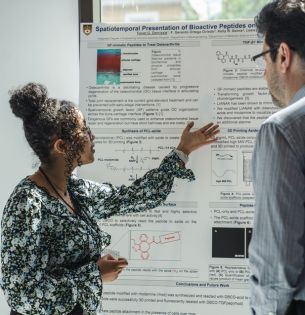
The student must complete a professional quality poster and provide a contribution to the Department web page based on his/her M.S. thesis research.
Master of Engineering
There are two paths that one may choose for the Master of Engineering degree program.
The first path is a Master of Engineering degree which would include five core courses among 30 credit hours of courses, with the aim of eventually pursuing the PhD degree. In this case, the core course selection is the same as for the Master of Science degree (see above). Students who choose this option may apply for the PhD program if they have a gpa of at least 3.35 in their five core courses.
The second path is the Master of Engineering degree with some or no core courses. The student takes 30 credit hours of courses, satisfying the requirements indicated below. If a student subsequently desires to pursue the PhD degree, he/she should aim to complete the five core courses, either after or while obtaining th
General Requirements for Master of Science and Master of Engineering Degrees
In meeting the requirements for the Master of Science or Master of Engineering degree, the student must satisfy the following common requirements, as outlined in the Graduate Student Handbook.
- All candidates for a Master's degree must submit the form entitled Program for Master's Degree as soon as possible after accruing 15 credit hours of courses but no later than the semester before the student graduates. This form is eventually approved by the Registrar. The timing for completion of this form is critical, as it allows for corrections to a student's course plan if necessary.
- The minimum program for all Masters degrees includes:
• Not less than 30 credit hours of graduate work; audit credits may not be used toward the degree. Research or thesis registration counts as part of the 400-level course requirement.
• Not less than 24 credit hours of 300- and 400-level coursework of which at least 18 hours is at the 400-level.
• Not less than 18 credit hours in Mechanical Engineering and Mechanics
• Not less than 15 credit hours of 400-level coursework in Mechanical Engineering and Mechanics.
- No course in Mechanical Engineering and Mechanics below the 300-level may be used to satisfy a Master's degree. However, a maximum of two courses (6 credits)at the 200 level and above outside of Mechanical Engineering and Mechanics can be used to satisfy the degree requirements, subject to approval by the advisor and the Departmental Graduate Committee, as part of a strong justification of a coherent course plan.
- The Master's degree is not granted unless the candidate has earned grades of B- or better in at least eighteen hours of the work on his or her program and in all 300-level courses in Mechanical Engineering and Mechanics. No course in which the grade earned is less than C- is credited towards the degree.
- A student who receives more than four grades below B- in courses numbered 200 or higher becomes ineligible to qualify for the Masters degree or to register for any other 400-level courses.
given semester.
Master of Business and Engineering Degree (MBA&E)
Following are the requirements for the Master of Science degree in Business and Engineering (MBA&E) in the Department of Mechanical Engineering and Mechanics.
As stated by the College of Business and Economics, MBA and Engineering degree Requirements, the general requirements are as follows:
- 12 core credit hours, plus 6 elective credit hours, consisting of: Engineering ME 452, Analytical Methods in Mechanical Engineering, plus 15 credit hours of graduate-level courses in Mechanical Engineering and Mechanics, one of which may be at the 300 level.
- 1 credit hour of an integrative project.
A detailed listing of core courses in Mechanical Engineering and Mechanics, along with a description of electives is as follows:
12 core course credit hours: ME 452, Mathematical Models in Engineering I, plus any three additional courses selected from the following core courses in Mechanical Engineering and Mechanics
ME 413 Numerical Methods in Mechanical Engineering OR
ME 453 Mathematical Methods in Engineering II
ME 423 Heat Transfer
ME 430 Fluid Mechanics
ME 401 Product Development OR
ME 402 Manufacturing
Mech 406 Fundamentals of Solid Mechanics
Mech 425 Dynamics and Vibrations
6 elective credit hours: Any two additional 400-level courses in Mechanical Engineering and Mechanics or one additional 400-level course in Mechanical Engineering and Mechanics and one 300-level course in Mechanical Engineering and Mechanics, which is allowable if at least one 400-level course is taken in the College of Business and Economics.
1 credit of Integrative Experience: An independent project is carried out under the guidance of a Mechanical Engineering and Mechanics faculty member to satisfy this requirement.