Building and electronics. Math and machinery. And hard.
These are a few of the words that a group of students came up with to describe engineering. But their teacher asked them to focus on a different word: Creativity.
“Who else is creative?” he asked. “Artists, architects, musicians, writers. Engineers are more closely aligned with writers than they are with scientists.”
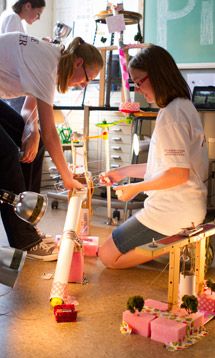
The teacher was William A. Best, professor of practice in electrical and computer engineering at Lehigh University. The students were girls in sixth, seventh and eighth grades participating in Lehigh’s week-long CHOICES summer camp.
CHOICES – which stands for Charting Horizons and Opportunities in Careers in Engineering and Science – is an outreach program designed to introduce young women to engineering. In addition to the summer camp, it includes a one-day event each spring that brings about 60 girls to Lehigh’s campus.
“Through hands-on laboratory work, field trips and discussion exercises, CHOICES gives girls a chance to experience engineering,” says Best.
Women are underrepresented in engineering. Fewer than 19 percent of engineering students in the United States are women (compared with 25 percent at Lehigh), and only about 13 percent of working engineers are women.
Lehigh began the one-day CHOICES program in 1993 to try to change this; the summer camp was added in 2004. Since then, more than 1,300 girls have gone through both programs.
“Our goal was to help girls to understand that science can be fascinating and fun,” says Susan Reilly Salgado, who started the program as director of college programs under Harvey Stenger, who was then dean of Lehigh’s engineering college.
“Of course, we want all kids to be excited about science. But the primary focus here was on changing the perception that science and math are only for boys.”
Many of the girls who attend CHOICES already like science and math, but they may have few female role models and conclude that those areas are uncool to study. Furthermore, they’re typically not familiar with engineering. It can be easy to assume that engineering just involves building bridges or machines, but the girls learn that it encompasses a wide array of disciplines.
During both the summer camp and the day in the spring, volunteers from Lehigh’s Society of Women Engineers (SWE) introduce the girls to civil, environmental, electronic, computer and biomedical engineering, and materials science.
By performing fun experiments, the girls learn the applications of some of each field’s basic disciplines. And by working with the SWE mentors, they get to see what women engineers look like.
“CHOICES demonstrates to girls that they can be anything they want to be,” says Lori Cirucci, who teaches science at Broughal Middle School in Bethlehem, Pa., and sends students to CHOICES each year. “Look at all these women who are studying engineering. Do they look like geeks to you? No, they don’t. They look like you and me. My students recognize that engineering is very doable for them and not just a guy thing.”