Photomechanics Laboratory

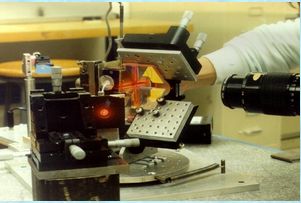
The Photomechanics laboratory at Lehigh University was started by Dr. Arkady Voloshin in 1984. The main purpose of the lab is development and application of the modern optical methods in experimental mechanics. The laboratory has several optical systems capable to analyze a wide variety of problems utilizing principles of photoelasticity, classical moiré, moiré interferometry, fiber optic sensors and image processing and analysis.

Moire Setup

The main research thrust is focused on development of the optical methods for strain and displacement analysis. The main applications are in the area of the microelectronics packaging:

effect of the coatings on the stresses in die

residual stresses and warpage due to the manufacturing of the microelectronics package

stresses due to the die-attach procedure


The assessment of experimental data is performed on the basis of the "Digital image analysis enhanced analysis of fringe patterns". This work received an M. Hetenyi Award from the Society for Experimental Stress Analysis.
Recently a new approach for non-contact analysis of the windshield and architectural glass distortion was developed based on the image analysis of transmission and reflection patterns.


Back to Home Page

Biomechanics Laboratory

During locomotion every impact between the foot and ground generates a shock wave that propagates through the whole human musculoskeletal system and reaches the forehead. Due to the significant difference in the stiffness of bones and soft tissues, it is reasonable to assume that the main carrier of these waves will be bone. Thus, the only logical way to measure those waves is the attachment of a wave sensor to the bone. However, such an approach has not found widespread application due to the obvious inconvenience and, more importantly, the possible danger to the well being of the subject. An alternative approach, attaching the sensor externally, enables the evaluation of the effects of soft tissue on acquired data and avoids the above-mentioned inconveniences and dangers.

Runner


Study of Shock Propagation in Human System


The acquired data may be used for in-situ evaluation of the shock absorbing properties of various footwear, shoe insoles, external prosthesis, etc. The same approach may be used for analysis of the shock protection ability of various car and truck seats. In addition, one can analyze performance of number of exercise machines in order to evaluate the amount of shock waves invading the human musculoskeletal system due to the use of those machines.

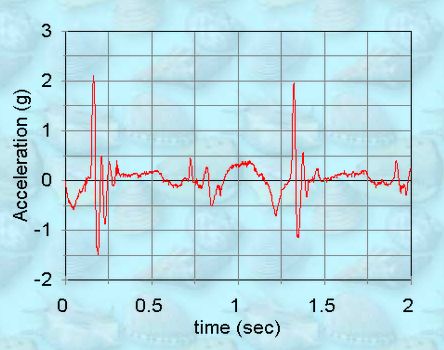
A lightweight accelerometer can be attached at the tibial tuberosity, on the sacrum, forehead or any other location where there is a relatively thin layer of skin over the underlying bone. These accelerometers measure the frequency and intensity of shock waves propagated in the longitudinal directions of the tibia, spine and at the forehead. Each accelerometer is attached externally to the point of measurement by a metal holder tightly strapped to the skin by elastic strips. Such attachment is capable of faithfully measuring the amplitude of a shock wave. The subject then walks or runs on a treadmill or over ground at prescribed speed and the acceleration data is acquired. During the test, acceleration data may be recorded continuously or at specified time intervals. Data Acquisition The accelerometer data is acquired on-line via A/D converter connected to PC. The data may be sampled at up to 10000 Hz per channel and stored for later processing. The example of the typical acceleration pattern recorded on the tibial tuberosity during walking is shown above.

Cell Mechanotransduction

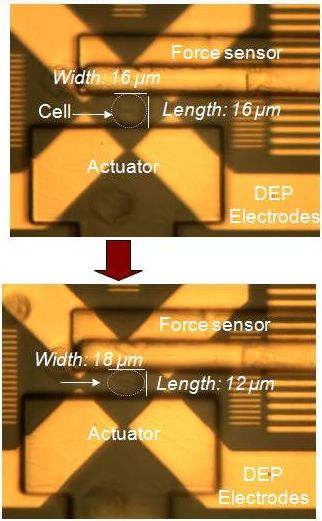
A study of the mechanical compliance of biological cells is critical to the study of the pathophysiology of various diseases and to the search for effective treatments. Biologists hypothesize that the biomechanical properties of osteoblasts change as a function of age, and this change could be a contributing factor to the pathogenesis of osteoporosis. To examine  the osteoblasts’ mechanosensitivity a polymer-based MEM device that integrated an electrothermal actuator array, a cell-positioning system, a force sensor, and a thermal sensor on a single chip has been built  This actuator was used to apply compression on different types of cells and evaluate their time-dependent behavior. These measurements are useful to study mechanotransduction, cell adhesion, and other phenomena of interest in tissue engineering.


A NIH3T3 fibroblast cell was compressed up to 4 µm (25% strain) by the actuator in cell medium.


Back to Home Page