Timothy J. Foley
Associate Director, Computing Center
Lehigh University
Bethlehem PA 18015
tjf0@lehigh.edu
Roy A. Gruver
Director, Administrative Systems & Telecommunications
Lehigh University
Bethlehem, PA 18015
rag3@lehigh.edu
For many, the World Wide Web is a place of amazement and confusion. Like a spider's web, its architecture is flexible and its applications are often intriguing and picturesque. Also like a web, applications can exist without much substance, they are sometimes sticky and difficult to navigate, and the links may not connect important parts. Lehigh University has exerted great effort into untangling the Web and using it as an interactive presentation environment. This environment presents a coherent institutional image and a broad range of campus services. A key focus of this paper will be the effort Lehigh has placed on "marketing" WWW: demonstrating its ability to support relatively sophisticated departmental and institutional applications; providing campus-wide development training; involving key departmental partners in early development; and providing institutionally-funded development assistance.
The past half decade has profoundly transformed the way campuses have conceptualized and developed information systems. The rapid acceptance of client/server technology, and specifically the WorldWide Web (WWW), has created a new paradigm for campus information systems.
Lehigh's implementation of World Wide Web (WWW) technology began as a grass roots effort by a few departments. This seminal effort bore positive results. It also made Lehigh realize that a concerted effort to build university-wide consensus on the value and usefulness of WWW was needed. The process at Lehigh has been referred to as "controlled anarchy", but the results have been impressive; the entire campus-wide information system is available on the Web; student prospects can "visit" campus through the online Viewbook; numerous departments have created their own homepages with some even running their own WWW servers; hundreds of Alumni have registered under the Alumni homepages and an Alumni Web page has been created to link Alumni to Lehigh from around the world. The Admissions Office feeds web-based prospect information forms into the institutional admissions and recruiting system; Administrative Systems is developing an Oracle-based "virtual kiosk" application for the Web; and they are also working on improving information flow throughout the campus using the online forms facility.
Over the last five years, Lehigh's information environment has been shaped by Lehigh's five-year strategic plan for computing and communications. This plan was developed in the spring of 1990 and finalized in the fall of 1991. The plan called for movement from a mainframe environment to a client/server environment utilizing the Unix operating system. It also stressed the importance of providing high-speed network connections in every office, classroom, and residence hall room. The removal of the mainframes was accomplished with the installation of over 150 IBM RS/6000 computers including numerous high-end IBM RS/6000 computers to act as Compute, File, and Communication Servers for the campus. Campus high-speed network connections have been evolving rapidly with major projects underway to connect all offices through the recently established Network Support group. High-speed network connections are also available to all students living in residence halls through the WIRED (World-wide Information Resources in Every Dorm) project which is a joint undertaking of the Computing Center, Telecommunications, and Residential Services. An extensive network of publicly available microcomputers is also in place to provide web access to everyone on-campus.
Another positive force in the evolution of Lehigh's Information environment is the merging of the Information Technology groups with the University's Libraries. Lehigh has always had a strong working relationship between these two groups with many joint ventures such as the installation of over 75 networked microcomputers and workstations in the libraries; the installation and system support of an IBM RS/6000 running the OCLC's SiteSearch software and the Library's web server; the implementation of many tools on Lehigh's Campus-wide Information System that were directly inspired by Library requests; and the installation and support of the Library's on-line catalog system running on an IBM RS/6000.
Another important element in untangling the web at Lehigh is the transformation of Lehigh's CWIS interface to a web-based interface. Lehigh's CWIS provides the following applications to a user base of over 7000 active accounts: electronic mail, bulletin board and conferencing facilities, access to national and international networks, on-line forms and survey processing, fax delivery and retrieval, and an access point for library services. This system is widely used by the campus with 95% of the community using the system on a regular basis. Lehigh's CWIS was developed in 1986 running on an IBM 4381. The IBM 4381, which utilized flat ASCII files that were accessed by a control file, was replaced in 1991 with a distributed database model using the Oracle database management system on a cluster of RS/6000s. This distributed database model has allowed the client portion of the CWIS interface to run on the web. Faculty, departments, and campus groups automatically have their existing information placed on the web through this Oracle/WWW interface. Lehigh is currently working on improving this interface to provide many of the same features as Lehigh's current terminal-based interface.
Lehigh's CWIS was based on the concept of "distributed services" encompassing both the management and the location of databases and applications. The "distributed services concept has been easily adapted to Lehigh's WWW. Data management activities are the responsibility of individual topic coordinators. Topics on the CWIS are fed, nurtured by, and are the responsibility of, the information providers. Another aspect of distributed services is the ability to access designated hosts or data directories. Distributed applications are being explored to allow selected applications to transparently run on another host. The overall goal is to move from a tightly coupled cluster supporting all available services to a more diffuse system.
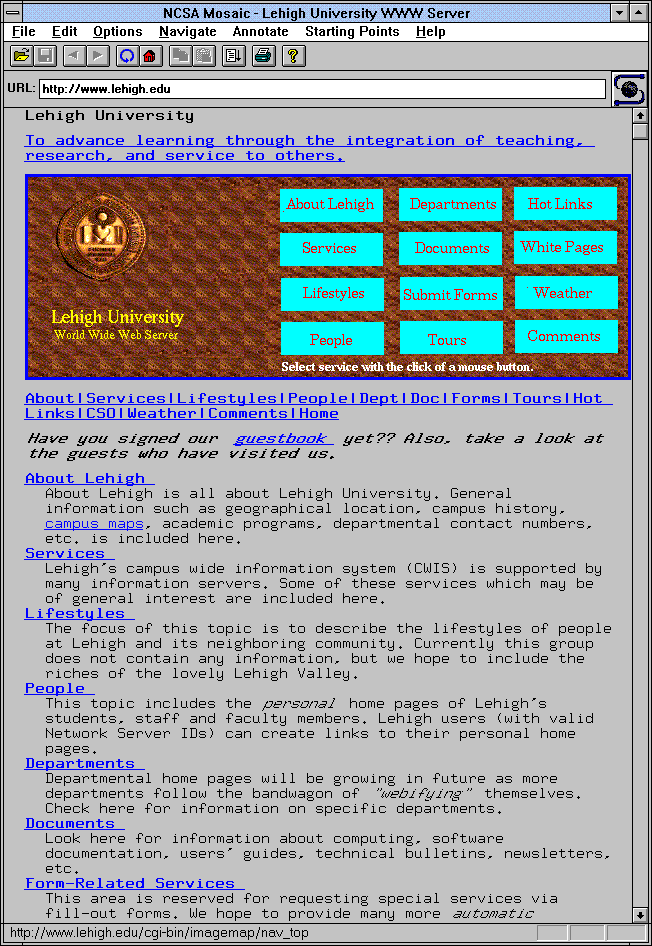
The marketing of the web to the campus community has been an integral part of Lehigh's web strategy. The first web server was setup in November of 1993 with the Computing Center developing a prototype which included an image map (see figure 1) and links to each of these areas. The prototype also included an interactive campus map utilizing scanned images of the campus which were already in place on Lehigh's gopher server. Parts of the existing University catalog were scanned in to develop a hypertext version of the catalog. On the lighter side, experimental pages were developed such as the "Chocolate Milk Guide of the Lehigh Valley" with milk ratings in terms of number of cows. The Computer Store established a web server with a video camera to scan the store's main floor every 60 seconds and display the image on the web so customers can check if the store is busy before coming to the store. Once this was done, the University's Media Relations group became involved with design suggestions and also by placing on-line many of Lehigh's current publications.
To spread the word of WWW capabilities and provide training to the campus community, a number of initiatives were undertaken. Web seminars were added to the Computing Center's seminar schedule. Separate faculty seminars were also developed which included the use of a digital camera to get faculty pictures on-line and placed on their individual homepages. From the outset, Lehigh's web initiative encouraged individual homepages and also encouraged the linking and creation of homepages for Alumni. Departments were given individual presentations on the value of the web to both the internal functioning of the campus and as a mechanism for presenting Lehigh to the outside world. The President's council and the Board of Trustee were given presentations on the uses of the web at Lehigh and around the world. Special training sessions were given to the Library Staff who also setup their own web server which is linked from Lehigh's main page. This summer, special seminars were given to train one person from every administrative office on the development of HTML documents. These seminars were requested by the Administrative Vice President.
Policies, standards, and guidelines were developed for the web. The issues associated with computing policy are magnified by the ease of use and access to world-wide information through the web. The extensive use of graphics, video, and sound caused concerns about copyright issues and also network bandwidth issues. Policies were in place to manage these issues and are placed prominently on-line. At Lehigh, information providers agree to abide by these policies when web accounts are issued to departments or campus groups. Individuals who create their own homepages must agree to abide by Lehigh's policies before being given an account to create a homepage.
Style guides and suggested formats are made available on Lehigh's web, but departments are on their own to design and develop what they want. The Computing Center decided at the start that departments and groups would be responsible for the design and creation of their individual pages with training provided by the Computing Center. Student Web Authoring Teams (SWAT) have been formed to work with the Computing Center staff and also with individual departments to develop and implement homepages. The departments actually pay for these students out of their own budgets once the students have received training through the Computing Center. A perfect example of this is the work done by one of the SWAT members to place the current University catalog on-line. The SWAT student recruitment process revealed that many students wanted to become involved with creating HTML documents, and the Center had to turn away many qualified students.
Another part of marketing was the tracking of usage and monitoring of comments in Lehigh's guestbook. The usage statistics reveal the global nature of the web, especially when they show that the University's homepage is being accessed by people from around the world on a regular basis. Comments to Lehigh's guestbook such as:
have been used to illustrate to the University the diversity of the people viewing Lehigh's homepage. It also should be pointed out that Lehigh's guestbook, and also student's individual homepages, have been abused at times and Lehigh has moved from a rather open policy concerning postings to a more controlled environment. For example, last October when the Computing Center was presenting an overview of the web for the entire Administrative wing of the University, looking at the guestbook produced two images of Barney along with a couple links to dating services. Students have posted inappropriate materials on their homepages and have been referred to the Dean of Students for disciplinary action. The entrepreneurial students at Lehigh have also gone into the homepage business to advertise for companies for a charge and they have also set up server sites for distributing adult materials. The student homepage and server issues are covered in the University's Computing Policy.
Another marketing strategy was the involvement of the entire campus in the design of Lehigh's current homepage . It was felt that the campus departments would have a sense of ownership if they were involved in the design and implementation of the University's homepage. This page was designed with input from all departments on campus as to its organization and content. It is currently undergoing another round of revisions and will probably turn into a yearly review task. The amount of suggestions about our current homepage were minimal with most ideas coming from the Computing Center and Media Relations. Other departments were still getting use to the web as a tool for marketing the University and their services. Lehigh's next revision should have more input from other departments as they become more familiar with the web.
And finally, when marketing the web, it is important to get recognition of its value from the highest level in the University as possible. The Dean of the Engineering College has created a homepage for the College and encourage all departments to develop their own homepages. Similar initiatives are occurring at the other Colleges and departments on campus. Lehigh's President has recorded several messages [wav] which have been placed at appropriate places on the web. Audio and video players, such as Real Time Audio, are being investigated to provide a better mechanism than is currently available to distribute sound and video. The Center first saw Real Time Audio when the Athletics department made arrangements with Taylor Subscription TalkTM out of Tulsa, Oklahoma to broadcast its football games on the web.
The creation of virtual kiosks for the University is a high-priority of the Administrative Systems group. The abundance of workstations and PCs connected directly to the high-speed network make the virtual kiosk concept the logical solution for access to student, faculty, and staff information. Students should be able to access their own personal and academic information from anywhere on-campus, especially from their own rooms. Faculty and staff should also be able to access their personal and payroll information through web-based screens. Administrative Systems has explored several different implementations for Lehigh's virtual kiosk and believe that a web-based approach has the most promise. To this end, a number of pilot applications have been developed to demonstrate the flexibility, simplicity, and richness of the web as an application development environment. People from outside the University should also be able to request and receive information. Web-based software that automatically generates mailings and responses is currently being developed. For more than a year, web-based requests for general and admission information have been received from interested students and parents. Further, the web is being used for a repository of operational information and the forms facility has been used to simplify on and off-campus communications.
The word "web" no longer evokes thought of spiders on most college campuses and one can hear references to it on a daily basis in news and television media. As the web and the Internet have continued to grow at exponential rates people are just beginning to determine the many ways that they can use these new technologies. Cooperation between all departments on campus is essential for providing up-to-date information for both on and off campus users. Training and marketing of the current and future capabilities of WWW technologies is a necessary and daunting tasks that needs to be done to allow campuses to fully exploit the web.
NUMBER OF ACCESSES: