Study Abroad
Home > Students > Getting Started > Programs > Summer/Winter Faculty Led > Lehigh in Costa Rica
Click here for Summer Program
Click here for Winter Program

Read about our first cohort in summer 2012!
APPLICATION DEADLINE: Rolling admissions. Click here for further details!
INFORMATION SESSION
Click here for information session times.
Talk to a past participant!
PROGRAM DATES
Service Learning : August 7 - 21, 2013
Summer Internship: July 1 - August 21, 2013
PROGRAM DIRECTOR
Professor Donald Morris
Earth and Evironmental Science
dpm2@lehigh.edu
PROGRAM COSTS
Service Learning : $1,400 (tentative) – This includes a family home-stay in the San Luis Valley for the nights of August 7 - 21, 2013. The program cost also includes an international Student ID Card. Not included: airfare, local travel, meals outside the program, laundry, personal expenses, personal weekend travel and/or other costs.
Summer Internship: $3,000 (tentative)
PROGRAM OVERVIEW
Summer Programs in Sustainable Development in Costa Rica
The Lehigh in Costa Rica Program has operated study abroad courses for over 14 years. The close association developed between Lehigh’s faculty and a variety of Costa Rican NGOs has allowed us to expand our program to include 2 new sustainable development initiatives: 1) A 5-week summer internship program, and 2) A summer environmentally-oriented community service project. Both activities are closely tied to sustainable development as described below.
The Programs’ Objectives
The goal of both projects is to augment classroom education currently available to students in environmental science or environmental studies with practical on-the-ground experience in sustainable development projects. Students will work on projects related to conservation, particularly in the area of building and/or maintaining biological corridors. The sustainability and integrity of Costa Rica’s environment is crucial to the ecotourism strategy of sustainable development for which Costa Rica is well known. These programs are designed to address the following educational goals:
- Allow students who lack the time or financial resources for a semester-long study abroad program to participate in international learning experiences.
- Create international opportunities specifically tailored to students with an academic background or general interest in the environment and/or international development.
- Demonstrate the inherent interdisciplinary character of “sustainable development” studies by emphasizing the connections among environmental conservation, economic development, and social/economic equity.
- Provide students with an appreciation for the environmental aspects of sustainable development in rural Latin America and expose students to issues related to conservation and preservation of biotic and ecosystem diversity.
- Expose students to Latin American culture and reinforce Lehigh’s connection with various NGOs in Costa Rica.
The 5-week Internships
Interns will begin the program on the Lehigh campus by participating in a series of modular “bootcamp” workshops that will be conducted during the preceding spring semester. These modules will include content on the basic principles of sustainable development as well as instruction in ecosystem ecology, conservation, and environmental policy relevant to their impending activities in Costa Rica.
After arriving in Costa Rica, students will spend approximately 5 weeks in internships with NGOs focused on various aspects of forest conservation related to sustainable development. Students can choose to spend the entire internship working for a single NGO or divide their time between 2 different NGOs. The specific internship(s) will be selected for each student according to their particular interests and their Spanish language proficiency (some will require a high level of fluency while others may not).
The last 2 weeks of the internship program will be conducted at the University of Georgia’s Costa Rica campus in San Luis. In this element of the program, students will work collectively and specifically on the study and establishment of the Pájaro Campana Biological Corridor (this experience overlaps with a 12-day Environmental Community Service Project described below).
Depending upon whether a student qualifies, the bulk of the cost of the internship (including accommodations and transportation) may be paid by the Lee Iacocca International Internship Program. Non-qualifying students will be billed according to the specific costs associated with each internship opportunity. Approximate dates of the program are July 1 to August 21, 2013.
Environmental Community Service Project
This 12-day Environmental Community Service Project will be conducted in the San Luis Valley of Costa Rica, just below the famous Monteverde Cloud Forest Reserve. Conservation activities will focus on the Pájaro Campana Biological Corridor which forms part of the Mesoamerican Biological Corridor that stretches from southern Mexico through Panama. Conservationists are actively involved in preserving and reforesting critical sections of this biological corridor. The resulting new forest patches will help to improve forest connectivity throughout the Pájaro Campana Biological Corridor and will directly contribute to the establishment of new habitat for a variety of animal species including the three-wattled bellbird and the resplendent quetzal, two migratory species greatly impacted by habitat loss in this region. Reforestation is also part of a broader effort to engage local landowners as part of the solution by developing market-based incentive programs which will provide income to them for reforesting degenerated pastures and protecting existing forests on their farms.
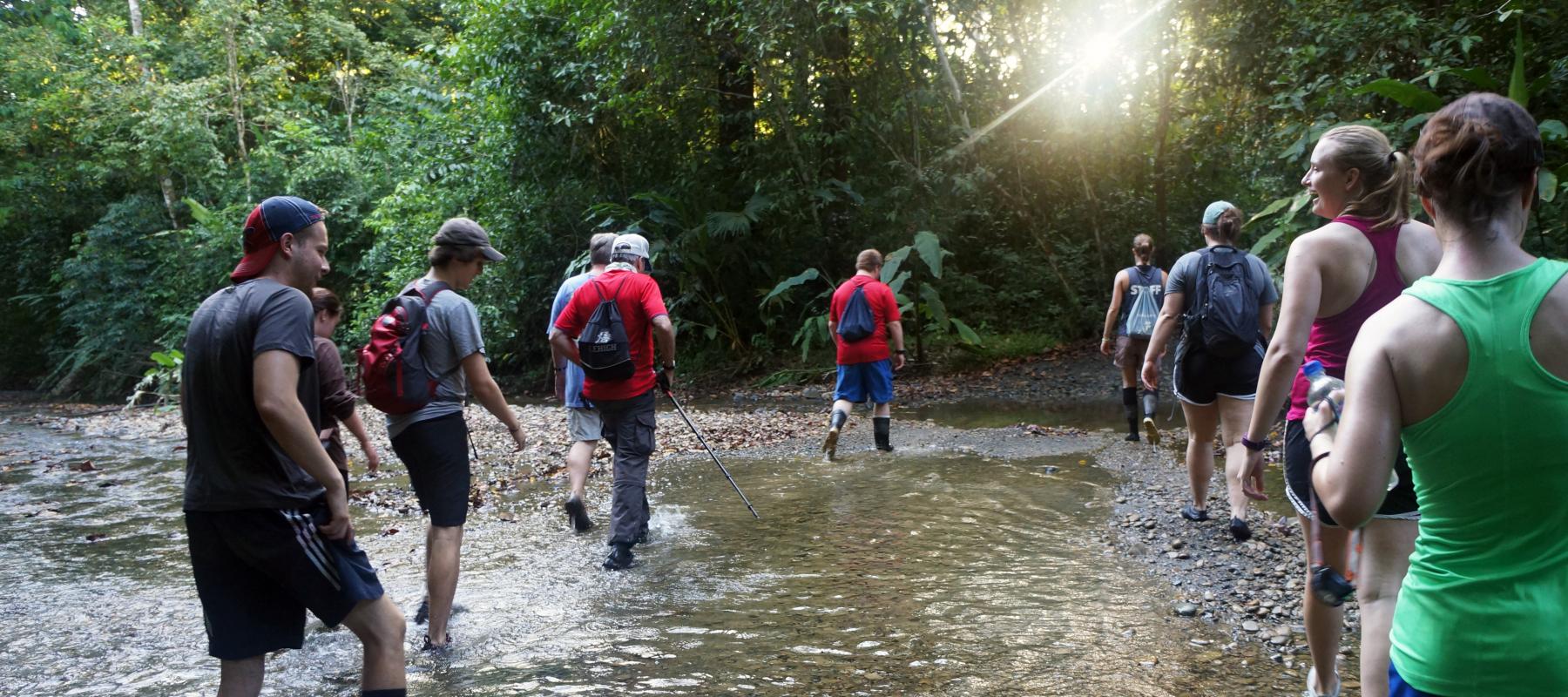
Lehigh students participating in this program would be involved in the reforestation efforts which are critical to preserving biodiversity in this region. They will also be involved in ecological research to evaluate the extent of existing forest fragmentation as well as the success of reforestation efforts. These efforts are substantially more than “just planting trees.” A few possible student activities are provided below:
- Map land-use and forest cover in the region using GPS. Map the fringes of existing forest tracts as well as mapping forest fragments. The resulting GIS coverage would be critical in assessing existing deforestation and planning future reforestation strategies.
- Locate and map areas of past reforestation. Once located, the success of these reforested tracts can be evaluated based upon seedling survival, viability, and community structure.
- Make annual measurements of tree growth in reforested tracts. The resulting estimates of growth rate could be converted into carbon sequestration rates.
- Work in the nursery related to the propagation of indigenous tree species.
- Help plant trees from the nursery into the forest.
These activities will help Lehigh students gain an appreciation for conservation issues and help them to better understand the important link between policy, economics, land use, and conservation. Students with an academic background in environmental science will constructively apply their skills to real-world problems, while practicing skills related to data collection and interpretation.
The community service project will be centered at the University of Georgia campus in San Luis, Costa Rica. Students will be housed with families (home-stays) throughout the San Luis Valley. The community service project will require a substantial amount of field work but will also include academic and cultural activities. Partial financial support for students may be available through Lehigh’s Taskforce for Sustainable Development (ask for details). Projected dates for the Environmental Community Service Project are August 7 - 21, 2013.
LOCATION
Costa Rica is an ideal location to study sustainable development because it has been woven into the fabric of Costa Rican society and constitutes the core of Costa Rican development strategy. Costa Rica has made progress in the area of prosperity and social equity. Remarkable progress has also been made in the environment through extensive preservation of large tracts of land. In fact, about 26% of Costa Rica has been preserved as national parks, reserves, and conservation areas. Most of these tracts are owned by the national government but many are also held by private individuals and conservation trusts. Tourism has been an important industry in shaping the economic development of Costa Rica (it represented ~10% of GDP in 2010). Much of the growth of tourism is linked specifically to “ecotourism” which attracts visitors to the country largely based upon its rich ecosystem and biotic diversity. In many regions of Costa Rica, ecotourism is the instrument that connects conservation to economic development. Thus, progress in conservation has the potential not only to protect biological diversity, but to synergistically expand economic activity through ecotourism.
Although Costa Rica has had remarkable success with respect to forest management, many undisturbed tracts exist as fragmented, isolated “islands” in a landscape that has become degraded by agriculture, tourism, or urbanization. One of the most pressing conservation goals in Latin America is to reconnect many of these tracts of land with intact biological corridors via the Mesoamerican Biological Corridor which stretches from southern Mexico through Panama. Conservationists are actively involved in preserving and reforesting critical sections of this biological corridor. The resulting new forest patches will help to improve forest connectivity and will directly contribute to the establishment of new habitats for a variety of animal species. Reforestation is also part of a broader effort to engage local landowners as part of the solution by developing market-based incentive programs which will provide income to them for reforesting degenerated landscapes and protecting existing forests on their farms. Reforestation efforts will eventually attract ecotourism to the region which will stimulate economic development.
The conservation activity described here has impacts well beyond Costa Rica. Because reforestation sequesters CO2 (a “greenhouse” gas), it has implications for global climate and for the development of global scale policies to “offset” or mitigate anthropogenic CO2 emissions. The conservation activities described here are also easily transferred throughout Central America (and beyond) to link critical conservation and economic development goals inherent in the concept of sustainable development.
ACCOMODATIONS
Service Learning : The community service project will be centered at the University of Georgia campus in San Luis, Costa Rica. Students will be housed with families (home-stays) throughout the San Luis Valley.
Summer Internship: (TBD)
COURSES OFFERED
**Non-credit-bearing international service-learning or internship program
APPLY NOW!
Lehigh University
Study Abroad Office
32 Sayre Drive, Coxe Hall
Bethlehem, PA 18015

Lehigh in Costa Rica Winter 2012-13 Flyer!
APPLICATION DEADLINE: Rolling admissions. Click here for further details!
INFORMATION SESSION
Click here for information session times.
Talk to a past participant!
PROGRAM DATES
December 26, 2013 - January 12, 2014
PROGRAM DIRECTOR
Professor Donald Morris
Earth and Evironmental Science
dpm2@lehigh.edu
PROGRAM COSTS
* A limited number of scholarships are also available. Applications will be evaluted according to a student's financial need and an essay describing the possible significance of this experience to their academic and professional development.
$3,790 (tentative) – This includes tuition for three credits, double occupancy room for the nights of December (TBD), 2013 to January (TBD), 2014 and breakfast. The program cost also includes an international Student ID Card. Not included: airfare, local travel, meals outside the program, laundry, personal expenses, personal weekend travel and/or other costs.
PROGRAM OVERVIEW
ES-122 and EES-042 are 18-day courses taught simultaneously in Costa Rica during winter break. You may enroll in only ONE of these courses concurrently. Both courses require some class meetings and academic work during the preceding fall semester
(see dates listed below).
LOCATION
Costa Rica is a small (size of West Virginia) Central American nation which lies on a narrow strip of land separating the Pacific Ocean and the Caribbean Sea. Costa Rica’s tropical climate, geographic location, and evolutionary past have combined to provide a rich diversity of habitats and a spectacular array of biota. Habitats range from mangrove swamps to rain and cloud forests to seasonal dry forests and alpine meadows situated near active volcanoes. This small strip of land boasts over 10% of the world’s bird and butterfly species, as well as over 1,200 species of orchids!
Costa Rica is internationally recognized for its innovative approaches to conservation and sustainable development. At considerable economic cost, the country has preserved over 25% of its land area as national parks or private reserves. Costa Rican society is currently debating the trade-offs between economic development and environmental preservation. The Costa Rican experience provides numerous real-world examples of the complex and diverse forces that threaten tropical ecosystems and various attempts to preserve these ecosystems and still grow economically.
Compared with other Central American nations, Costa Rica has been blessed with remarkable stability: few extremes of wealth and poverty, no standing army, and a proud history as the region’s most stable democracy. The country is a growing destination for ecotourism and hosts a number of university field courses on tropical ecology.
ACCOMODATIONS
Students will depart for San Jose, Costa Rica on (TBD) and return on (TBD). In Costa Rica, transportation and accommodations will be arranged by the Organization for Tropical Studies (OTS), which has substantial experience operating similar educational programs in the region. While at OTS’s biological stations, students will be housed in student dormitories. In San Jose and other populated areas, students will be housed (multiple occupancy) in hotels.
COURSES OFFERED
EES-042 The Natural History of Costa Rica
(3 credits/Natural Science)
This course will expose students to the unique interaction of ecology, geology, and climate that has shaped the natural history of Costa Rica. Topics will include population, community, and ecosystem ecology, as well as evolution and natural selection as they pertain to the biota of Costa Rica. Biodiversity and conservation biology will also be a major focus of the course. It will expose students to the natural history of Costa Rica via classroom lectures, electronic media, observations, and field exercises.
For more information, CLICK HERE
ES-122 Sustainable Development: The Costa Rican Experience
(3 credits/Social Science)
This course investigates the concept of sustainable development as it is currently being practiced in Costa Rica. The course is an examination of sustainable development and its implementation in Costa Rica. Students investigate sustainable agriculture and energy, ecotourism, land use planning and management, and the issue of biodiversity vs. resource exploitation in forests. Students also learn about Costa Rica, its social fabric, history, government, and culture.
For more information, CLICK HERE
Lehigh University
Study Abroad Office
32 Sayre Drive, Coxe Hall
Bethlehem, PA 18015 |