World Press Freedom Day Briefing Debates Role of Social Media in Journalism

By Sarah Freeman

image There are more than 500 million users of Facebook, and 175 million followers on Twitter. YouTube gets 2 billion hits per day. All of these people posting links, tweeting headlines and uploading videos are decimators of information, and they channel it through the Internet. This new crop of citizen news sources is defining today’s media, but do they count as journalists?

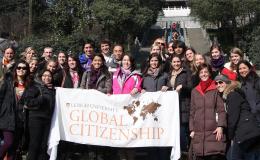
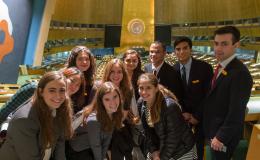
This was one of the main debates among panelists at the United Nation’s World Press Freedom Day special briefing “21st Century Media: New Frontiers, New Barriers” on May 4th. Nine Lehigh students attended the conference, which was one of the highest-level briefings Lehigh has attended as a result of its Non-Government Organization standing with the United Nations.

World Press Freedom Day is celebrated to honor the signing of the Windhoek Declaration. Twenty years ago African journalists gathered to capture the sense of hope and optimism for the future surrounding the Cold War and recent independence of Namibia. The declaration was a statement from these journalists calling for a global shift to a more independent, pluralistic and unregulated media in order to secure social equality and support democracy. The declaration applied mostly to print journalists suffering from censorship, government interference, harassment and targeted attacks.

In the past two decades the press has played an active role, providing checks on governments and publicizing moves toward democracy. At the same time, they suffer incredible losses for their work; since 1991, 102 journalists have been killed. Print journalist are not the only ones at risk, the rise of the Internet has introduced citizen journalists who also need protection and free access to information.

Gwen Lister, editor of The Namibian, knows the struggles of fighting for media freedom. She started her career during the height of the South African occupation of Namibia. Her opposition to apartheid led to her arrest, and subjected her to death threats prior to Namibia earning its independence. Lister said at the time the Declaration was signed; print media did not foresee the new media movement. Lister argued that social media had no role in a journalist conference, but that online content is still subjected to the same hurdles of print media. While the Windhoek Declaration was a call from African media to “break the chains of government,” ratifications in the declaration and governments who simply ignore it, still limit access to information and freedom of expression.

Egyptian blogger and editor of Manalaa, Allaa Abd El Fattah, said he had a difficult time talking about the limitation of freedom of speech after the Egyptian moment overcame any obstacles presented by the government. However, he agreed with Lister that social media is not journalism. While it had a role in the recent revolution, it was not a cause. Fattah said the Internet was a tool for assembling the revolution, but the building blocks were already in place. These included disgruntled labor unions, increased cost of living, more educated and technologically advanced youth and apathy toward the government. Blog, videos and social media sites united and mobilized these parties by framing their arguments on the Internet. Fattah described the gathering in Tahrir Square as “18 days of perfection,” during which activists were stripped of the technology that united them and defended themselves with ancient technology such as rocks and sticks.

“We should not mistake an effect from a cause,” said Graham Usher, an independent journalist who has covered the Middle East and South Asia for 20 years, about the use of social media in overthrowing dictators. User sees two red flags with the popularization of social media. The first is giving it too much credit. Revolutions have been happening for centuries without the aid of technology, and while in many of the recent revolutions, it acted as a tool for revolution, Usher said, it was not an underlying factor that called for the revolution. In addition to the presence of activists on social media sites in Egypt, the Egyptian revolution was also catalyzed by the Tunisians overthrowing their dictator, the poor who were not online but took to the streets, the military that did not take action against the protesters, and Mubarak continuing to make mistakes that further infuriated Egyptian citizens. The second flaw of social media, according to Usher, is people mistaking social media sites are credible, partisan and objective. Usher said mainstream media is getting lazy because it relies on social media. However, he said what social media does offer is a chance to capture history as it is being made by the activists who are not only recording it but participating in it.

After the panelist’s spoke, the discussion opened up to questions. Samantha Russell, a junior global studies major, said, “As a student I am always prompted to asked questions.” She asked the panelist how important the technology was that unified groups in Egypt and what would have happened without that technology or if that technology was banned by the government?

Fattah responded by sharing a popular joke circulating around Egypt now that it is exam time for high school students: A mother tells her child to get off the Internet and start studying or she is going to cut the child off. The child responded, “Do you know what happened to the last person who tried to do that?” He elaborated by saying this was the third revolution in 30 years and each one took a different shape based on the resources available. Revolutions are a reflection of a moment in history, Fattah said, and are not intrinsic in technology. The more important role technology will pay will be facilitating discussion about the future of post-revolutionary countries.

Other panelists included Sanja Tatic Kelly, a senior researcher and managing editor at Freedom House, and Abderrahim Foukara, the head of Al-Jazeera’s United States operations. Opening remarks were made by Ban Ki-moon, the eighth Secretary-General of the United Nations. After the briefing five of the Lehigh students along with Bill Hunter, director of the Global Union, attended a lunch with the panelists and other attendees of the briefing.

"Getting to sit down to lunch with the Director-General of UNESCO, the Under Secretary-General of the UNDPI and the President of Columbia University was overwhelming to say the least,” said Andrew Flowe, a senior global studies major. “It was a great cap to my four years at Lehigh, and certainly an experience I'll never forget."

-- Liz Piscitelli and Buddy Stevenson