Educational Leadership Program


A Day in the Life of Lehigh University Educational Leadership Master's student Spring Shank
Follow grad student Spring Shank, M.Ed., Educational Leadership, '19 as she share a day in her life!
Developing and supporting effective leaders in the field of education who are committed to improving the lives of every student.
Welcome to the Educational Leadership Program at Lehigh's College of Education. We offer graduate degree programs for those interested in furthering their studies in leadership within academic institutions.
Our Educational Leadership program offers a Master’s in Educational Leadership and a Doctoral degree in Educational Leadership. We also offer K-12 principal certification, director of curriculum and instruction certification, and superintendent of schools certification. We focus on K-12 education at both the national and international levels. The MEd in Educational Leadership is offered in hybrid or online option, with an optional certification.
Our alums are known for going above and beyond management and administrative tasks; they are trained to lead, advance, and improve educational systems. According to the U.S. Department of Labor Employment, the educational leadership job market is projected to grow by 6% through 2024 and we are committed to producing the best.
Our doctoral in Educational Leadership (Ed.D.) is designed to develop the abilities of individuals who want to lead within educational institutions and agencies in the U.S. and around the globe in international schools.
We offer a Pennsylvania Department of Education approved K-12 Principal Certification program designed for educators who are interested in leading schools. Lehigh knows that it takes great leaders to build and lead outstanding schools and communities.
The Urban Principals Academy @ Lehigh (UPAL) is a focused 13-month Master's (M.Ed.) + PA K-12 Principal Certification for individuals who work within educational environments in urban public schools (traditional and charter). It incorporates a hybrid model of delivery with two intensive summer sessions (five weeks each) that emphasizes themes of Creativity, Innovation, issues of bias and privilege, organizational culture and community building to provide a foundation for future urban school leaders to think differently about leading school communities. During the academic year, course work is offered using real time online learning delivery methods.
Individuals who are looking to direct the curriculum and instruction on a large scale within the school district can enroll in the Pennsylvania Supervisor of Curriculum and Instruction Certification program. Individuals who graduate from our program are district-wide specialists in curriculum and instruction and are responsible for supervising instruction and evaluating staff; designing and developing curriculum, learning materials and innovative educational programs; conducting experimental instructional programs, and directing and conducting basic or applied educational research.
For those who are looking to lead entire school districts we offer the Superintendent of Schools Certification program. This program is designed for educators who are interested in assuming a position as a Superintendent and leading, advancing and improving entire communities.
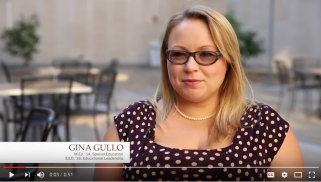
Learn more about our Educational Leadership degree program's from our students!
Gina Gullo, Educational Leadership, M.Ed. Special Ed, '14 and Ed.D. Educational Leadership, '16
Our mission in the Educational Leadership program is to develop and support effective leaders for high-quality elementary/secondary education. In partnership with the global community, we identify and enhance individuals through degree and certification programs and support their lifelong learning through our conferences and publications.
Our vision of effective leaders is working collaboratively as scholar-practitioners who foster the cognitive and affective development of all learners both through technological, managerial, and interpersonal skills as well as through agile and creative habits-of-mind.
Features of our program include:
-
Personalized advisement and attention
-
Excellent instruction by full-time faculty
-
Balance of theory and practice
-
Earned reputation for quality
-
Proven placement record
Announcement
The Urban Principals Academy @ Lehigh (UPAL) is a focused 15-month M.Ed. + PA K-12 Principal Certification for individuals who work within educational environments in urban public schools (traditional and charter). It incorporates a hybrid model of delivery with two intensive summer sessions (five weeks each) that emphasizes themes of creativity, innovation, community building and team work to provide a foundation for future urban school leaders to think differently about leading school communities. During the academic year, course work is offered using real time online learning delivery methods.
