INFLUENZA EPIDEMIOLOGY AND EVOLUTION
Because viruses can reproduce so rapidly and produce such large numbers of progeny, the effects of natural selection can produce evolutionary change in viruses over a shorter time scale than seen for complex organisms. In general, RNA genome viruses can undergo evolutionary change quicker than DNA genome viruses. This is because most viral DNA polymerases have a proofreading activity but viral RNA polymerases do not. Thus, a random nucleotide mistake made by the viral genome replicating enzyme would almost always be immediately repaired in dsDNA but not in RNA. So, there will be much more inherent variation at the nucleotide sequence level in a replicating population of an RNA virus than for an otherwise similar DNA virus. Because essentially all RNA viruses have a genome in the range 10-20Kb, it's possible to make a general statement that "In RNA viruses, roughly one nucleotide per genome is incorrectly reproduced in each replication." (Quote from review article by Bonhoeffer and Sniegowski, Nature, Nov. 28, 2002, page 367.) For influenza, viral evolutionary change is actually an important aspect of the replicative success of the virus in human populations.
1. What are the properties of Influenza virus relevant
to its ability to undergo noticeable evolutionary change?
There are several properties that "come together" in influenza that make evolutionary change particularly noticeable and important for this virus. The main factors are:
(1) The viral RNA polymerase that replicates the viral RNA genome does not have a proofreading capability.
(2) The virus genome is in 8 pieces.
(3) Various strains of Influenza A virus can productively infect multiple mammalian and avian species. (This is not generally the case for strains of Influenza B virus.)
(4) The main immune response to influenza infection is the synthesis of antibodies that recognize portions of the HA glycoprotein that do not have to have a specific conserved structure for HA function.
2. What are the mechanisms of the processes of "antigenic
drift" and "antigenic shift" by which influenza virus undergoes
evolutionary change?
Antigenic drift is a result of the gradual accumulation of mutational
changes in the genome. Some of these changes will be neutral and some will be
favored ("disfavored" changes will not accumulate in the population).
From the beginning to end of a winter "flu season", or from one winter
to the next, a given strain of influenza virus may change by a percent or so
at the nucleotide sequence level. (One percent of 12 Kb is 120
nucleotides.) Thus, there is a gradual change at the amino acid
sequence level in some parts of some of the viral proteins. Over a decade or
so, a given "strain" of influenza virus can change quite significantly
in, for example, the region of HA to which antibodies bind. So, your memory B cells (and memory T cells) from a case of flu you
had just a few years ago may not be able to protect you from getting the flu
from "the same strain" now.
Antigenic shift is a sudden major change in antigenic type. This can result from a mixed infection (in a single
cell) with two influenza type A strains, producing a new strain with some genome
pieces from each original strain. Strains of influenza A are defined mainly by their HA and
NA structures, since these two virion surface glycoproteins are the major targets
of antibody binding. So, if we imagine an "H1N1" strain and a "H2N2"
strain infecting the same cell in the same organism (human or non-human), we
could expect that it might be possible that one of the new virions produced
from this infected cell might have the "H1" HA-coding RNA piece and
the "N2" NA-coding RNA piece. If this new mixed-genome virion is indeed
infectious, it could be the beginning of a "new strain" of influenza
A virus, "type H1N2". (This kind of recombination
to produce a new strain is not necessarily limited to the HA and NA genome segments;
thus, we could imagine that there may be various possible viable combinations
that could result from an infection with two strains.)
3. What were the major influenza pandemics
of the past 50 years or so?
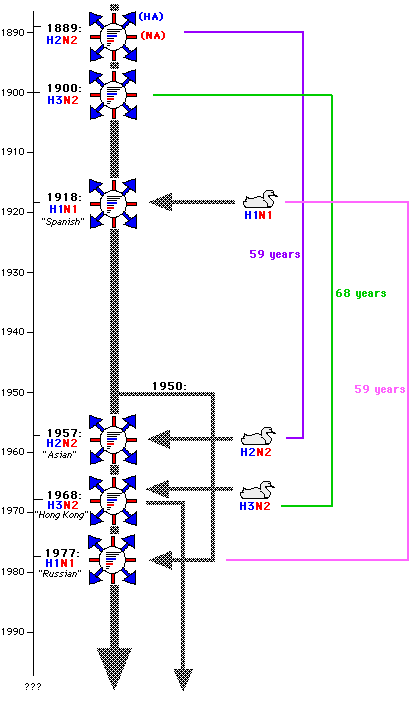
A simplified history of influenza in the 20'th century is
provided in this diagram from the late 1990's,
showing the antigenic shifts that resulted in several pandemics. (The information about the 1890 and 1900 pandemics must be considered to be speculative, because influenza virus was first isolated in the 1930's.)
Throughout the 1930's, 40's, and early 50's, H1N1 was the only Influenza A strain in circulation in people. In 1957, the "Asian flu" pandemic was due to an antigenic shift to H2N2 (with the almost total disappearance of H1N1). Eleven years later, in 1968, the "Hong Kong flu" pandemic was due to an antigenic shift to H3N2 (with the almost total disappearance of H2N2). Molecular analyses have shown that both the 1957 and 1968 pandemic viruses were a result of the reassortment of a human strain with an avian strain. The "Russian flu" of 1977 was due to a re-emergence of H1N1, but with the continued major presence of H3N2 in the population. H1N1 and H3N2 have remained in circulation, while undergoing continuous antigenic drift, for nearly 30 years now.
The great “Spanish” influenza pandemic of 1918-1919 is described in a 2006 special article in Emerging Infectious Diseases by Taubenberger and Morens titled “1918 Influenza: the Mother of All Pandemics.” Here are the first two paragraphs of this article:
An estimated one third of the world's population (or ≈500 million persons) were infected and had clinically apparent illnesses (1,2) during the 1918–1919 influenza pandemic. The disease was exceptionally severe. Case-fatality rates were >2.5%, compared to <0.1% in other influenza pandemics (3,4). Total deaths were estimated at ≈50 million (5–7) and were arguably as high as 100 million (7).
The impact of this pandemic was not limited to 1918–1919. All influenza A pandemics since that time, and indeed almost all cases of influenza A worldwide (excepting human infections from avian viruses such as H5N1 and H7N7), have been caused by descendants of the 1918 virus, including "drifted" H1N1 viruses and reassorted H2N2 and H3N2 viruses. The latter are composed of key genes from the 1918 virus, updated by subsequently incorporated avian influenza genes that code for novel surface proteins, making the 1918 virus indeed the "mother" of all pandemics.
Throughout the 1930's, 40's, and early 50's, H1N1 was the only Influenza A strain in circulation in people. In 1957, the "Asian flu" pandemic was due to an antigenic shift to H2N2 (with the almost total disappearance of H1N1). Eleven years later, in 1968, the "Hong Kong flu" pandemic was due to an antigenic shift to H3N2 (with the almost total disappearance of H2N2). Molecular analyses have shown that both the 1957 and 1968 pandemic viruses were a result of the reassortment of a human strain with an avian strain. The "Russian flu" of 1977 was due to a re-emergence of H1N1, but with the continued major presence of H3N2 in the population. H1N1 and H3N2 remained in circulation, while undergoing continuous antigenic drift, for over 30 years now.
Take a look at Koelle et al., "Epochal Evolution Shapes the Phylodynamics of Interpandemic Influenza A (H3N2) in Humans" (Science, December 2006).
As 2010 began, it was not clear whether these long-circulating strains of influenza A would remain prevalent, or whether they would be largely replaced by the newly emerged and now widespread 2009 H1N1 virus.
4. What is the molecular characterization of the 2009 H1N1 pandemic strain and its evolutionary emergence?
The novel H1N1 strain that was first recognized in spring 2009 was characterized rapidly and reported in several major articles in summer 2009.
Newmann et al., Emergence and pandemic potential of swine-origin H1N1 influenza virus, Nature, 18 June 2009.
Smith et al., Origins and evolutionary genomics of the 2009 swine-origin H1N1 influenza A epidemic, Nature, 25 June 2009.
Morens et al., The persistent legacy of the 1918 influenza virus, NEJM, 16 July 2009.
Zimmer et al., Historical perspective - emergence of influenza A (H1N1) viruses, NEJM, 16 July 2009.
5. What is the current status of influenza in the US?
Look at the U.S. Dept. of Health and Human Services' flu website.
6. What is the current status of H5N1 avian influenza?
Near the end of the 1990's, the first documented infection of humans by an avian H5N1 influenza strain occurred. This strain was shown to be highly pathogenic in humans but not easily transmitted from person to person. In the years since, sporatic cases of human-to-human transmission have been documented for H5N1 strains.
For updated 2011 information, go to the H5N1 page at flu.gov.
7. What is an example of an early 2011 journal article on influenza?
Safronetz et al., Journal of Virology, February 2011: Pandemic Swine-Origin H1N1 Influenza A Virus Isolates Show Heterogeneous Virulence in Macaques.